








Yes, perfume, cologne and air freshener can set off a smoke detector, mainly when you spray them close to it. A smoke detector reacts to fine particles in its sensing chamber, and the droplets from a spray can look like smoke to the sensor. A spritz at the other end of the room rarely reaches the detector in that concentration; a burst of aerosol right underneath it can.
If an alarm sounds, treat it as a possible fire first. Check for smoke or flames and follow your escape plan or the building's instructions. Only once fire is ruled out does the perfume bottle become the suspect.
How a smoke detector decides there is smoke
A smoke detector does not recognise fire. It counts particles, in one of two ways.
Photoelectric (optical) detectors shine a light beam through a small chamber. In clean air the light misses the sensor. When particles drift in, they scatter light onto the sensor, and once enough light arrives the alarm sounds. According to the US National Institute of Standards and Technology (NIST), this type tends to be more sensitive to larger, light-coloured particles, the kind a smouldering fire produces.
Ionisation detectors keep a tiny electric current flowing between two plates. Particles entering the chamber weaken that current, and a large enough drop triggers the alarm. NIST describes this type as quicker to pick up the small soot particles of a flaming fire.
Some alarms combine both sensors. None can tell where a particle came from. NIST notes that alarms near kitchens can respond to particles from cooking even when nothing burns, and that a less sensitive detector would also be slower in a real fire.
Fire services name sprays among those harmless things. London Fire Brigade lists aerosol sprays next to steam, cigarette smoke and light cooking smoke as things alarm systems can react to. North Yorkshire Fire and Rescue Service advises using aerosols with care and, where possible, away from detector heads. Shropshire Fire and Rescue Service has reported call-outs caused by mist from an aerosol sprayed near a detector.
Perfume, cologne, air freshener and others compared
What matters is how much fine spray reaches the sensing chamber, and how fast. The table gives the general picture. It is not a test of specific products or alarms.
| Product | How it enters the air | When an alarm becomes more likely | What helps |
|---|---|---|---|
| Perfume or cologne (pump spray) | A small amount of fine droplets per press | Several sprays directly under or beside the detector, for example in a small hallway | Spray in another spot, with your back to the detector |
| Body spray or deodorant (aerosol) | A pressurised burst that hangs in the air | A long burst in a small closed room with a detector on the ceiling | Short bursts, door or window open, away from the detector |
| Air freshener (aerosol can) | Usually sprayed upwards on purpose, towards the ceiling | Spraying up near the detector | Spray at chest height into the middle of the room |
| Hairspray | A long, dense aerosol burst | Styling in a hallway or bedroom under a detector | Use it in the bathroom with the door closed |
| Fragrance diffuser | A continuous, low output of fine droplets | Output carried straight to the detector | See can a diffuser set off a smoke alarm |
So can cologne set off a smoke detector? In principle it behaves like perfume: both leave the bottle as the same kind of fine spray. Can air freshener set off a fire alarm? An aerosol can is the more likely candidate of the three, simply because people aim it at the ceiling, which is where the detector is.
Whether your alarm is the ionisation or the optical type does not change the practical advice. Both respond to particles, and no source we found gives a reliable rule for which type reacts more to fragrance sprays.
What to do when the alarm goes off
- Assume it could be real. Look and smell for fire. If there is any doubt, get everyone out and call the emergency number from outside.
- In a hotel, flat or office, follow the building procedure. Linked systems can alert the whole building, and resetting them is the job of the staff or the responsible person.
- Once fire is ruled out, clear the air. Open a window or door and let the spray disperse. Leave the detector where it is.
- Use the hush button only as the alarm's manual describes. Not every model has one, and it is meant for known false alarms.
- Note what happened. Which product, how far from the detector, how many sprays.
How to spray without waking the alarm
The fix is to change where and how you spray. The detector stays where it is, powered and uncovered.
- Spray perfume and cologne onto skin or clothing at close range, not into the air above you.
- Use aerosols in short bursts with a window or door open.
- Point air freshener into the middle of the room at chest height, never up at the ceiling.
- Keep automatic air fresheners out of the air path that leads to a detector.
- Maintain the alarm as its maker describes. Fire services point out that dust inside a detector can also cause false alarms, and advise gentle vacuuming of the outside and regular testing.
Never cover a detector, remove its battery or tape over it while you get ready. A covered detector is easy to forget, and it protects nobody.
If the alarm keeps reacting to ordinary use at a normal distance, ask the alarm's maker, your landlord or a fire-safety professional, and leave the device working in the meantime.
Hotels and shared buildings
The question "can perfume set off a fire alarm" often comes up in a hotel room, and there the stakes are different. Detectors in hotels, student housing and apartment blocks are frequently linked to a central panel. A false alarm there can mean an evacuation.
Get ready away from the detector, use sprays sparingly and keep the bathroom door closed while you shower. If the alarm does sound, follow the instructions and tell the staff what you were doing.
Home fragrance without a spray can
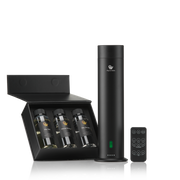
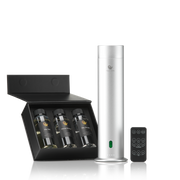
A continuous, low level of fragrance is an alternative to bursts from a can. The Pure One aroma diffuser works with cold air, without flame, heat or water, and has six intensity levels and a 1, 4 or 8-hour timer, so you can keep the output low.
A diffuser also releases fine droplets, so the same care applies: keep it out of the detector's air path and read our separate guide on diffusers and smoke alarms before you choose a spot. The diffuser placement guide helps with the rest of the room, and using an air purifier and diffuser together is covered separately.

No flame, no heat, no spray can
Waterless Aroma Diffuser – Matte Black
The Pure One aroma diffuser in matte black. Six intensity levels and a 1, 4 or 8-hour timer let you keep fragrance output low.
FAQ
Can perfume set off a smoke detector?
It can, if enough fine spray reaches the sensing chamber. That mostly happens when perfume is sprayed several times directly under or next to the detector.
Can cologne set off a smoke detector?
Yes, in the same way as perfume. The detector responds to airborne droplets, not to the type of fragrance.
Can air freshener set off a fire alarm?
Yes. Fire services list aerosol sprays among the known causes of false alarms. Air freshener is often sprayed upwards, towards the ceiling where detectors sit, so aim it lower and away from the detector.
Can perfume set off a fire alarm in a hotel room?
It is possible, and hotel detectors are often linked to a building-wide system. Spray away from the detector, never cover it and follow the hotel's instructions if the alarm sounds.
Can a scent diffuser set off a smoke alarm?
A diffuser makes no smoke, but its fine droplets can affect a susceptible detector if they are carried straight to it. Our article on whether a diffuser can set off a smoke alarm explains placement and what to do.