

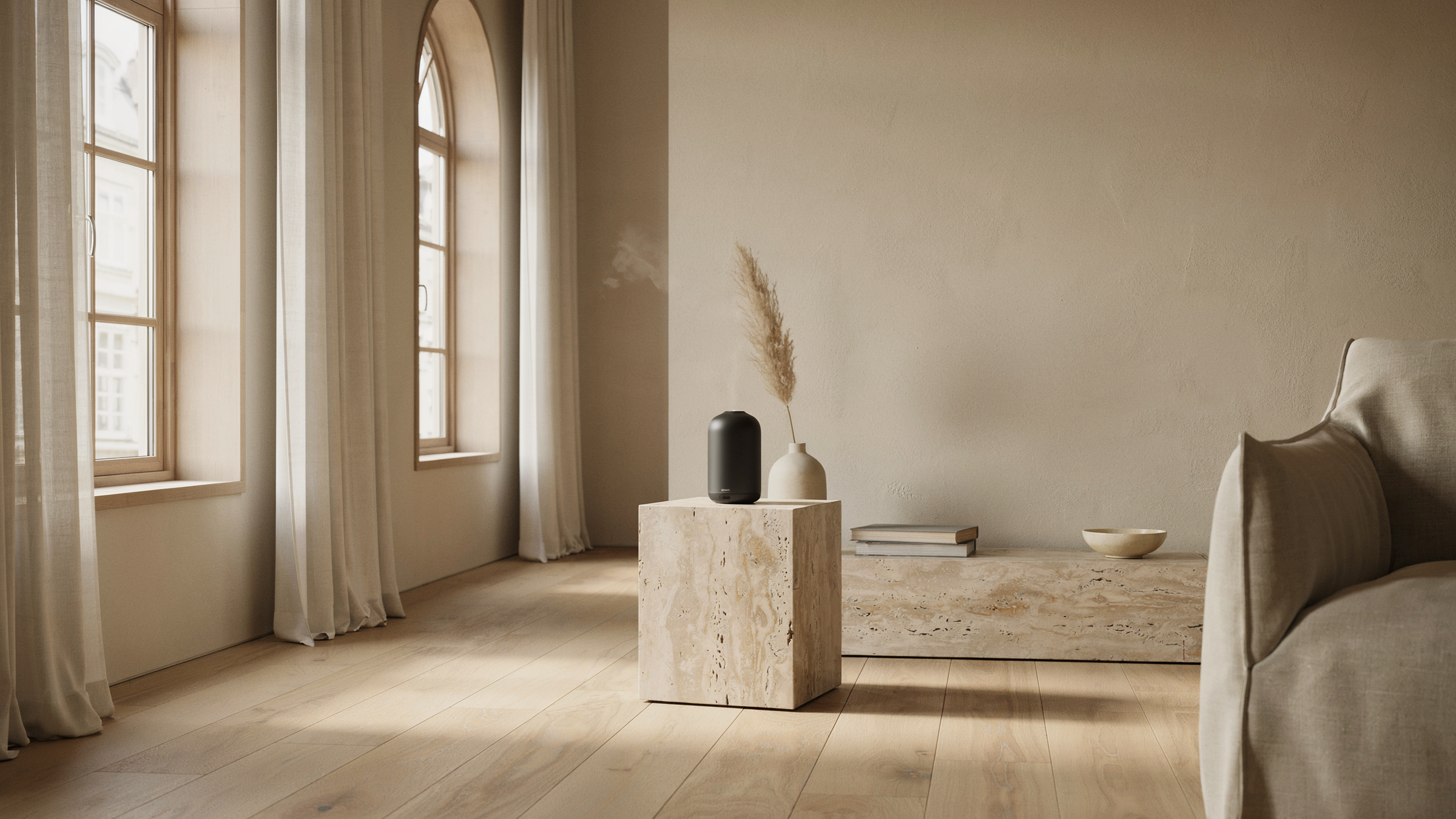
In most homes, a cold-air diffuser and a waterless diffuser describe the same kind of fragrance experience — just from two different angles. Cold-air describes how the oil is dispersed. Waterless describes what is left out: the water. Neither term tells you how well a specific model performs, which is the part worth checking.
If you are comparing scent diffusers online, the language can make a simple choice feel unnecessarily technical. One page calls a device a cold-air diffuser. Another calls it waterless. A third mentions nebulising. It is reasonable to wonder whether you are looking at three different systems.
Usually, you are not. This page explains what each term does and does not tell you. If you have already settled the terminology and want to compare it against a mist-based device, that comparison is in waterless versus ultrasonic diffusers.
What each term actually describes
A cold-air diffuser uses moving air to disperse fragrance oil, without warming it. A waterless diffuser works without added water. When a product is described as both, it normally means that it uses cold air to distribute fragrance oil directly, without diluting it in water or heating it first.
That is why the terms appear together. They are not competing technologies. They describe different parts of the same idea — one the method, the other the absence of a water tank. The exact construction and settings still vary by model, so the product page and manual remain the final word.
Why two names are used
The term waterless is useful because it distinguishes this category from a familiar ultrasonic diffuser. An ultrasonic diffuser has a water reservoir and combines water with a small amount of oil before creating a visible mist. A waterless system does not need that reservoir.
Cold-air makes the method clearer. It points to fragrance being dispersed without heating the oil. For someone choosing a diffuser, this matters less as a technical label than as a practical one: there is no routine of filling a water tank before each use.
Some brands use nebulising for a related method. The word describes turning oil into very fine particles. It should not be treated as a promise that every diffuser with that label performs in exactly the same way. Capacity, settings, oil compatibility and the room itself still shape the result.
What it feels like in daily use
The difference is easiest to understand at home, not in a specification list. With a waterless cold-air diffuser, you work with fragrance oil directly. You can generally choose when the diffuser runs and adjust the intensity to the rhythm of the room.
That suits a living room that needs a composed background scent in the morning, a more present welcome before guests arrive, or a quieter setting later in the evening. The aim is not to fill every corner with fragrance. It is to give the room a consistent atmosphere that feels considered rather than constant.
The Pure One is designed around this waterless cold-air approach: fragrance oil is dispersed without added water or heat, across spaces up to approximately 100 m². The right setting is always the one that suits your space, not the strongest one available.
Cold-air and waterless do not answer every buying question
These labels tell you something useful, but not everything. Before choosing a diffuser, look beyond the headline.
1. Start with the room, not the device
Think about the room as it is actually used. A small enclosed hallway of 5 m² asks for a different approach than a 60 m² open living space with doors opening, cooking nearby and people moving through it. Consider the size of the room, airflow and how often you want fragrance to be present.
2. Check which oils the model is made for
Use the oil type stated by the manufacturer. A diffuser and its fragrance oil work as a pair; treating all oils as interchangeable can affect the intended experience and the care routine. The hotel fragrance oils are formulated for cold-air dispersion specifically.
3. Look for control, not just a coverage number
A coverage figure is a starting point, not a guarantee. Settings matter because rooms change throughout the day. Adjustable intensity and timing give you room to keep the fragrance in proportion to the space — and they are also what determines whether a 120 ml bottle lasts two months or four, as set out in how long diffuser oil lasts.
4. Read the care guidance before you buy
Waterless does not mean maintenance-free. Every diffuser has its own cleaning and care instructions. A quick look at those instructions before buying is more useful than assuming that one name covers every detail.
When a waterless cold-air diffuser is the logical fit
This category is worth considering when you want a fragrance routine with more control than a passive option can offer, without adding water to the process. It can suit people who care about a refined, steady atmosphere in a living room, entryway, studio or open-plan home.
It is not automatically the right answer for every room or every preference. If your priority is simply a light scent in a very small space, another format may be enough. The useful question is not which label sounds more advanced. It is whether the way the diffuser works fits the way you live.
Where to go from here
- Comparing this category against a mist-based device: waterless versus ultrasonic diffusers.
- Deciding between reed, ultrasonic and waterless: which scent diffuser is best.
- Using one around children or pets: what to consider first.
- Ready to choose a device: the waterless aroma diffusers.
Frequently asked questions
Is a cold-air diffuser the same as a waterless diffuser?
Often, yes. Cold-air describes the way fragrance is dispersed, while waterless means the system does not use added water. Most devices labelled one way are also the other. Check the product description and manual, because terminology varies by model.
Does a waterless diffuser use heat?
A waterless cold-air diffuser is designed to disperse fragrance without added water or heat. For the exact operation and care requirements of a specific model, follow that product's instructions.
Is nebulising the same as cold-air diffusion?
The terms are often used for closely related fragrance-diffusion methods. Both can describe oil being broken into a fine dispersion without a water reservoir, but product design varies. Compare the manufacturer's guidance rather than relying on the label alone.
What should I check before buying a cold-air diffuser?
Check the intended room size and airflow, the compatible fragrance oil, the available intensity and timer settings, and the model's care instructions. Those four details predict the result far better than the name on the box.