

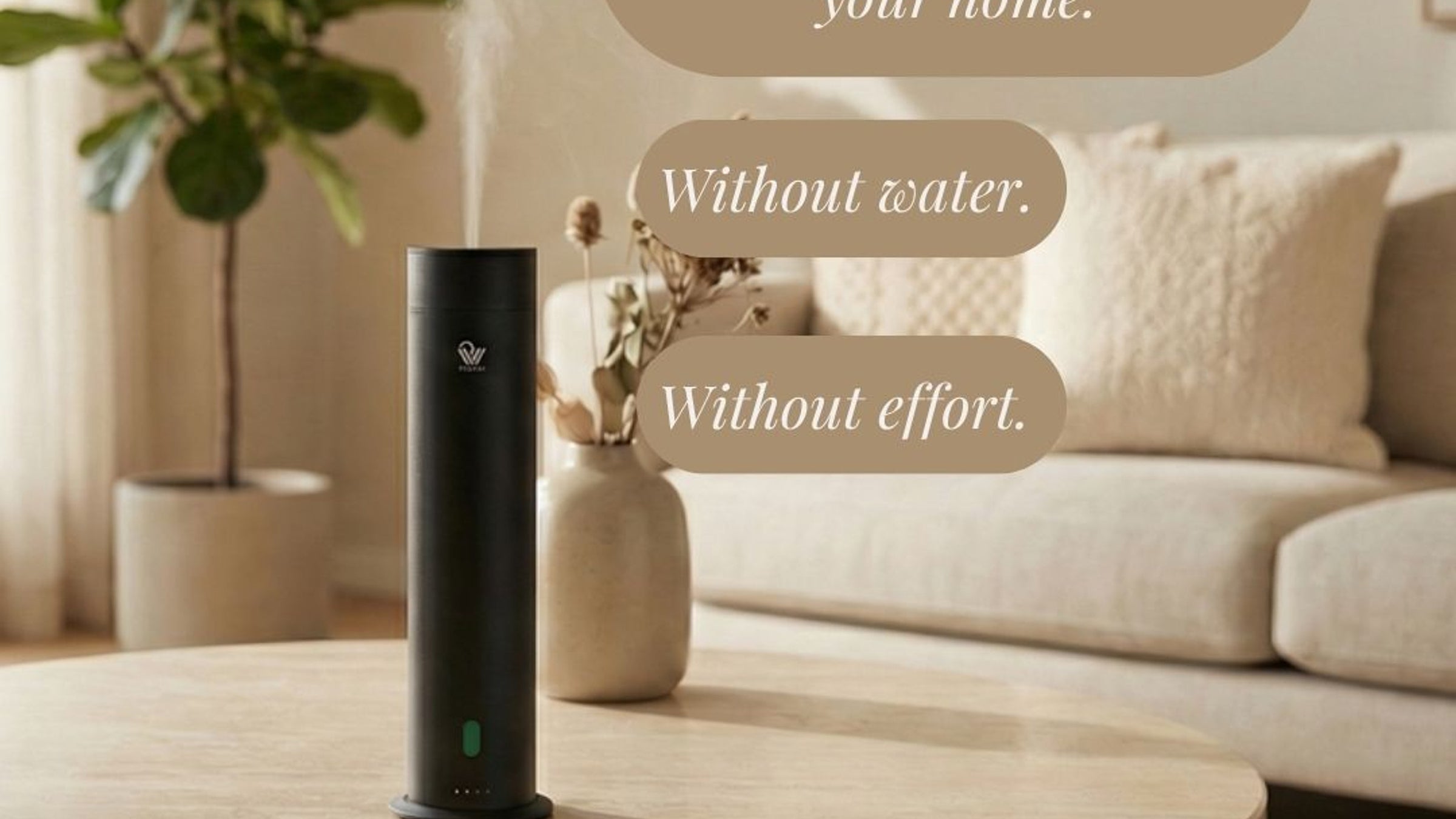
An open-plan kitchen-living-dining space should be treated as one fragrance zone with a single, well-chosen scent — not a different fragrance per functional area. Air moves freely through the whole space, so anything diffusing in the kitchen drifts into the living and dining zones within minutes.
The Short Answer
Use one fragrance across the connected space. Start with a single waterless diffuser on a low setting, positioned toward the living zone rather than the kitchen. Judge the result from several points after leaving and re-entering the room. Move the unit before increasing output, and add a second diffuser only for a persistent weak zone.
Why Open-Plan Rooms Are Deceptively Difficult
A large connected room is not one uniform box. A kitchen extractor pulls air in one direction, patio doors create a seasonal draught, and an L-shaped seating area can sit outside the main airflow entirely.
There is also a problem with the person doing the adjusting. You grow used to the scent within an hour and may push it well beyond what a visitor actually experiences. The goal is not identical intensity everywhere — it is a coherent background scent across the main route and seating zones, without a concentrated cloud beside the device.
Choose One Scent Identity
In a connected airspace, one balanced fragrance is far easier to control than several competing profiles. Different scents drift into each other within minutes when there is no door between them, which produces exactly the muddle most people are trying to avoid.
Because an open-plan area usually includes cooking, the scent also has to hold its own against food smells without clashing. Warm, well-composed blends with some depth work better here than delicate compositions, which get lost. The One is positioned for this kind of space: a fresh citrus and white-tea opening over sandalwood, amber and musk, substantial enough to register through a busy kitchen-living space rather than beneath it.
Placement Before Power
Start near the natural transition between entrance, dining and seating areas, with clear air around the unit. Avoid the furthest corner, the space directly under extraction, and any spot pointed into furniture. A stable console or sideboard at mid-height is a reasonable starting point.
Position toward the living zone rather than the kitchen. Extraction pulls air out of the room, so a diffuser near the hood can consume oil without meaningfully scenting the living side. The underlying principles are in the placement guide; they apply at a larger scale in open-plan homes.
A Measured Adjustment Routine
Resist the instinct to turn the intensity up the moment one corner feels weak. Instead:
- Record the diffuser's position, fragrance and setting.
- Run it at a low level for a full session rather than judging after a few minutes.
- Leave the room entirely, then re-enter through the normal doorway.
- Check the entrance, the main seating area and the furthest occupied point separately.
- Change only one variable — position or intensity, never both — before testing again.
If the entrance is strong and the seating area weak, move the diffuser rather than raising the setting. If every point feels weak, a modest increase is reasonable. If one corner is overwhelming, redistribute the existing unit before considering a second.
Manage the Kitchen Side
Fragrance should not be used to mask active cooking smoke or a drainage problem. Ventilate and address the source first — there is more on this in masking or removing bad odours.
Once the source is handled, let the room's gentler airflow carry fragrance back through the space from the living side.
When Two Diffusers Help
Open-plan spaces are often larger than a typical closed room, and a single diffuser starts to under-perform at the far end once the connected space goes much beyond roughly 100 m². A second unit also makes sense in a long L-shaped room, a double-height space, or a layout with a clearly disconnected seating wing.
Two units at opposite ends on a moderate setting give more even results than one unit pushed to maximum. Where coverage overlaps, use the same oil rather than two different scents, and judge the combination at the overlap point rather than beside either machine. The how many diffusers you need guide covers the calculation.
Where a Second, Different Scent Does Make Sense
If the open-plan area connects to a room with a door — a snug, home office or downstairs cloakroom — that room is a genuine separate zone and can run its own scent without clashing. The door acts as the boundary the open-plan space itself lacks. That is the point at which scent layering becomes possible.
Frequently Asked Questions
Should I use different scents in different zones of an open-plan room?
Generally no. Because air moves freely through an open-plan space, different scents blend at the boundaries rather than staying distinct. One well-chosen fragrance across the whole space usually works better. A room with a door is the exception — that is a genuine separate zone.
Where should I place a diffuser in an open-plan kitchen-living space?
Central to the living area rather than in the kitchen. Cooking smells and extractor fans compete with the fragrance and disperse it faster, so a diffuser near the hood consumes oil without scenting the living side.
How do I fix a weak zone without making the rest too strong?
Move the diffuser before increasing the setting. Test from several points after leaving and re-entering the room, and change one variable at a time so you can tell what actually helped.
Do I need two diffusers for an open-plan home?
Once the connected space goes much beyond roughly 100 m², or where there is a structural weak zone such as a long L-shaped room or a double-height space, a second unit helps. Two on a moderate setting beat one at maximum. Use the same oil where coverage overlaps.
Which scent works best in an open-plan kitchen-living space?
One with enough depth to register alongside cooking smells without clashing. Warm, well-composed blends over woods, amber and musk hold up better than delicate compositions, which get lost in a space that shares air with a kitchen.
Related: How Many Diffusers Do You Need? · Where to Place a Diffuser for the Best Scent Coverage · The Best Scent for Your Living Room