




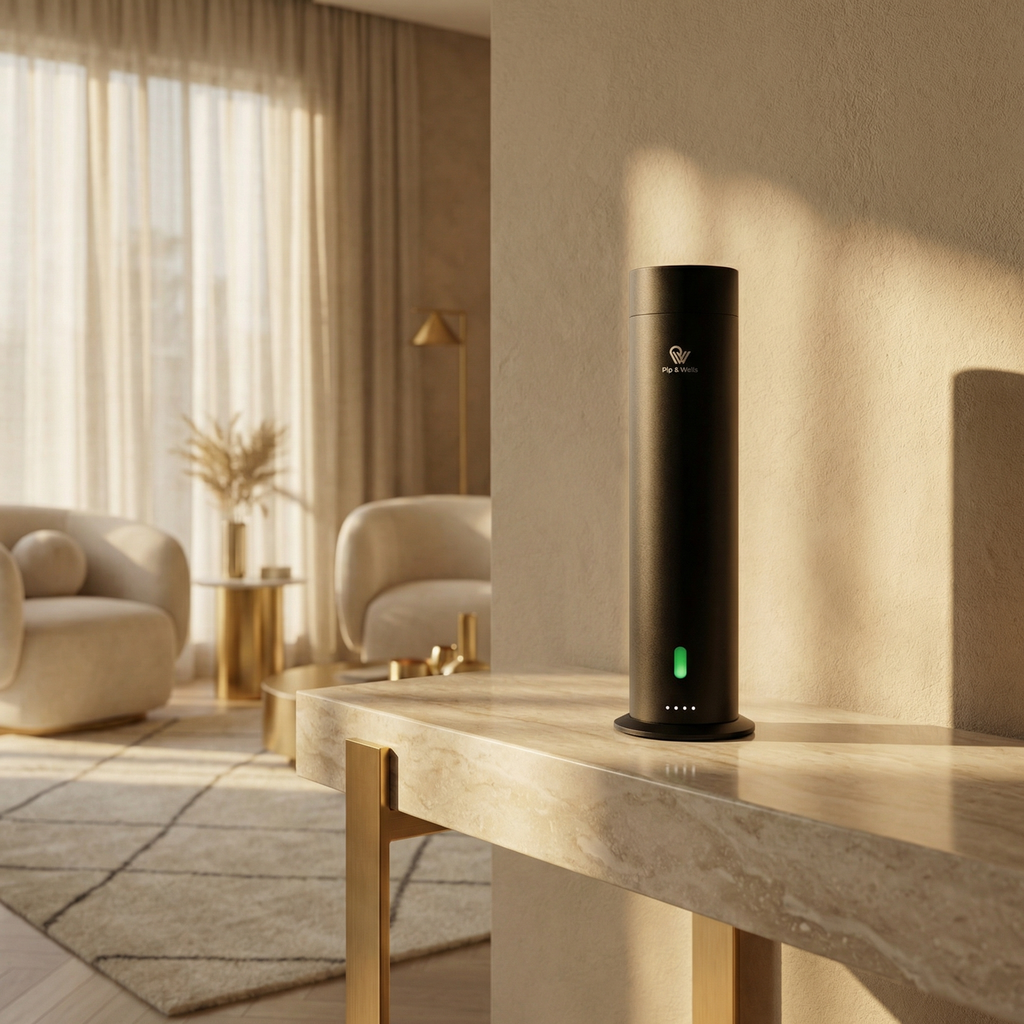
Short answer: a waterless diffuser uses a small air pump instead of a water tank. Air is pushed through a very narrow nozzle, which draws fragrance oil up from the bottle and breaks it into a fine, dry mist. The lightest droplets drift into the room; the heavier ones run back into the bottle. Nothing is diluted and nothing is heated, so the fragrance stays close to how it was composed. You control the strength with the intensity setting and the timer, not with how many drops you add. On the Pure One aroma diffuser that means six intensity levels, a 1, 4 or 8-hour timer and coverage of up to approximately 100 m².

No water, no heat, no tank to empty
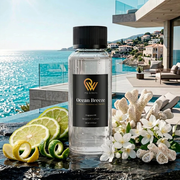
Waterless Aroma Diffuser Gift Set – Matte Black
Waterless diffuser + 3 hotel fragrance oils (120 ml). The bottle screws straight on; six intensity levels and a 1, 4 or 8-hour timer.
What "waterless" actually means
For most people, the first diffuser was an ultrasonic one. You fill a small tank with water, add a few drops of oil, and a vibrating plate at the bottom turns the water into a cool, visible mist. The water carries the scent.
A waterless diffuser leaves that step out. There is no reservoir to fill, no tank to empty and no cloud drifting across the shelf. A bottle of fragrance oil screws onto the device and the fragrance is released straight from it.
You will also see these devices called cold-air diffusers or nebulising diffusers. In practice the names usually describe the same category from different angles: one names the method, the other what is missing. If the terminology is what you came for, our page on cold-air versus waterless diffusers untangles it.
How a waterless diffuser works, step by step
The principle is older than any diffuser. Think of a vintage perfume bottle with a rubber bulb: you squeeze, air rushes past the top of a thin tube, and perfume leaves the nozzle as a fine spray. A waterless diffuser does the same thing, quietly and continuously, with a small pump instead of your hand.
- The bottle connects to the device. You screw a bottle of fragrance oil onto the diffuser. A thin scent tube reaches down into the oil, like a straw.
- A small pump moves air. When you switch the diffuser on, an internal air pump pushes air through a narrow channel towards a nozzle.
- Fast-moving air creates suction. When air speeds up through a narrow opening, its pressure drops. That low pressure draws oil up through the tube.
- The oil is broken into a fine mist. At the nozzle the oil meets the airflow and is torn into very small droplets.
- Only the finest droplets leave. Larger droplets hit the inside of the chamber and run back into the bottle. What comes out of the outlet is light enough to stay in the air and move through the room.
- The settings decide the dose. The intensity level determines how much fragrance is released; the timer decides for how long.
That last step is the practical difference. With a water-based diffuser you adjust strength by guessing drops. With a waterless one you choose a level and a duration, and the next evening you can repeat exactly the same thing.
What you notice at home
Less than you might expect, at first. Switch it on in the living room before dinner and there is little to see, perhaps a faint wisp right above the outlet. The fragrance arrives gradually. By the time you sit down, it no longer feels like something added to the room. It feels like part of the room.
Then something else happens: you stop noticing it. That is not the diffuser fading. It is your nose adapting, which it does with any constant smell. Someone who walks in from outside will notice the fragrance clearly while you barely register it. This is the most common reason people turn the level up too high. If you want to check, step outside for a minute and come back in.
As for sound: the pump makes a soft, even hum. In a living room with conversation or music you will not hear it. In a silent bedroom at night you might, which is why many people run it for an hour before bed with the timer and let it switch itself off.
How much oil does a waterless diffuser use?
More per hour than an ultrasonic diffuser, because the oil is not stretched with water. That is also why the scent is fuller. The settings make the difference here: a lower level and a timer use far less than running the device all day on its highest setting.
With the Pure One, one 120 ml bottle lasts roughly two to four months, depending on the level, the timer and the size of the room. Our guide to how long diffuser oil lasts explains where in that range you are likely to end up, and how long and how often to run it helps you find a rhythm that does not waste oil.
Which oil can you use in a waterless diffuser?
Use oil made for waterless diffusers. It has to be thin enough to travel up the scent tube and break apart at the nozzle. Thick oils, carrier oils such as almond or jojoba, and liquids made for reed diffusers are not formulated for this and can clog the tube or nozzle. Check the manual of your device before trying anything else.
The Pip & Wells hotel fragrance oils come in 120 ml bottles that screw directly onto the Pure One. If you are weighing fragrance oil against essential oil, the differences are set out in diffuser oil vs essential oil.
Waterless and ultrasonic side by side
| Waterless (cold-air) | Ultrasonic (with water) | |
|---|---|---|
| Water needed | No | Yes, refill the tank |
| Visible mist | Hardly | Yes, a clear cloud |
| Scent strength | Fuller, undiluted, adjustable | Lighter, diluted with water |
| Adds humidity | No | Yes, a little |
| Oil use per hour | Higher | Lower |
| Routine care | Change the bottle, clean now and then | Empty and clean the tank |
| Typical room size | Living room to open-plan, up to about 100 m² depending on the model | Small rooms, up to about 20–30 m² |
The full comparison, including when ultrasonic is the better choice, is in waterless vs ultrasonic diffuser.
Does a waterless diffuser leave residue?
There is no water, so there is no limescale and none of the white dust that ultrasonic diffusers can leave behind when they run on hard tap water. That alone is a reason many people switch.
The fragrance itself is oil, though. Used normally, the droplets spread through the room. If the outlet sits right against a wall, a shelf above it or a curtain, and the diffuser runs on a high level for hours, a little can settle on that one spot. Give the device some space and keep the outlet free; the placement guide shows where it works best.
Why you hardly see any mist, and when something is wrong
A fine, almost invisible output is normal. A waterless diffuser is not meant to look like a kettle. If you smell nothing at all after a while, check these points in order:
- Is the bottle screwed on fully and straight?
- Is there enough oil for the tube to reach?
- Is the scent tube seated properly in the bottle?
- Is the diffuser on a level you would actually notice in a room that size?
- Has the nozzle been running for months without cleaning, or with a thicker oil? Then follow how to clean a waterless diffuser.
Still nothing? The calm, step-by-step version is in waterless diffuser not smelling, and you can always contact Pip & Wells.
Is a waterless diffuser the right choice for you?
It suits you if you want to scent a living room, open-plan kitchen or studio of roughly 20 to 100 m², if you like being able to set strength and duration precisely, and if you would rather not fill and rinse a water tank. It also works well in rooms that are already humid, such as a bathroom, because it adds no moisture.
It is not the obvious choice if you want a humidifier, if a visible mist is part of the appeal, or if you only need a light scent in a very small room; reed sticks are often enough there. Not sure about size? The room size guide has a table per m². Using one around children or animals is covered in is a waterless diffuser safe for kids and pets.
Where to start
If this is your first waterless diffuser, the matte black gift set is the simplest beginning: the diffuser with three 120 ml hotel fragrance oils, so you can try which scent suits which room. If you already know your fragrance, the Pure One aroma diffuser on its own is enough. All finishes are together in the waterless aroma diffusers collection.
Frequently asked questions
Do waterless diffusers actually work?
Yes. Because the oil is not diluted with water, the scent is fuller and reaches further than with most ultrasonic diffusers. That you see little mist does not mean nothing is happening; the droplets are simply very fine. Give it time and judge it after stepping out of the room and back in.
Is a waterless diffuser the same as a cold-air or nebulising diffuser?
Usually, yes. Cold-air describes the method, waterless describes the absence of a water tank, and nebulising describes oil being broken into fine particles. The exact construction varies by model, so the product page and manual remain the final word.
Does a waterless diffuser need water?
No. The fragrance oil bottle connects directly to the device and the oil is released without water or heat. There is no tank to fill, empty or rinse.
Can I use reed diffuser oil or carrier oil in a waterless diffuser?
It is not recommended. Reed diffuser liquids and carrier oils such as almond or jojoba are not made for nebulising and can clog the scent tube or nozzle. Use oil made for waterless diffusers and follow the manual of your device.
Why is my waterless diffuser not misting?
A barely visible output is normal. If you smell nothing, check that the bottle is screwed on fully, that there is enough oil for the tube to reach, that the tube is seated properly and that the level suits the room. A nozzle that has not been cleaned for a long time can also block the flow.
How long does a bottle last in a waterless diffuser?
That depends on the level, the timer and the room. In the Pure One, a 120 ml bottle lasts roughly two to four months. A lower level and a timer make it last longer than running the diffuser all day.
Does the Pure One run on a battery?
Yes. The Pure One has a rechargeable battery for cordless use. You recharge it with the power adapter and USB-C cable. You operate it with the remote control or on the device itself.