

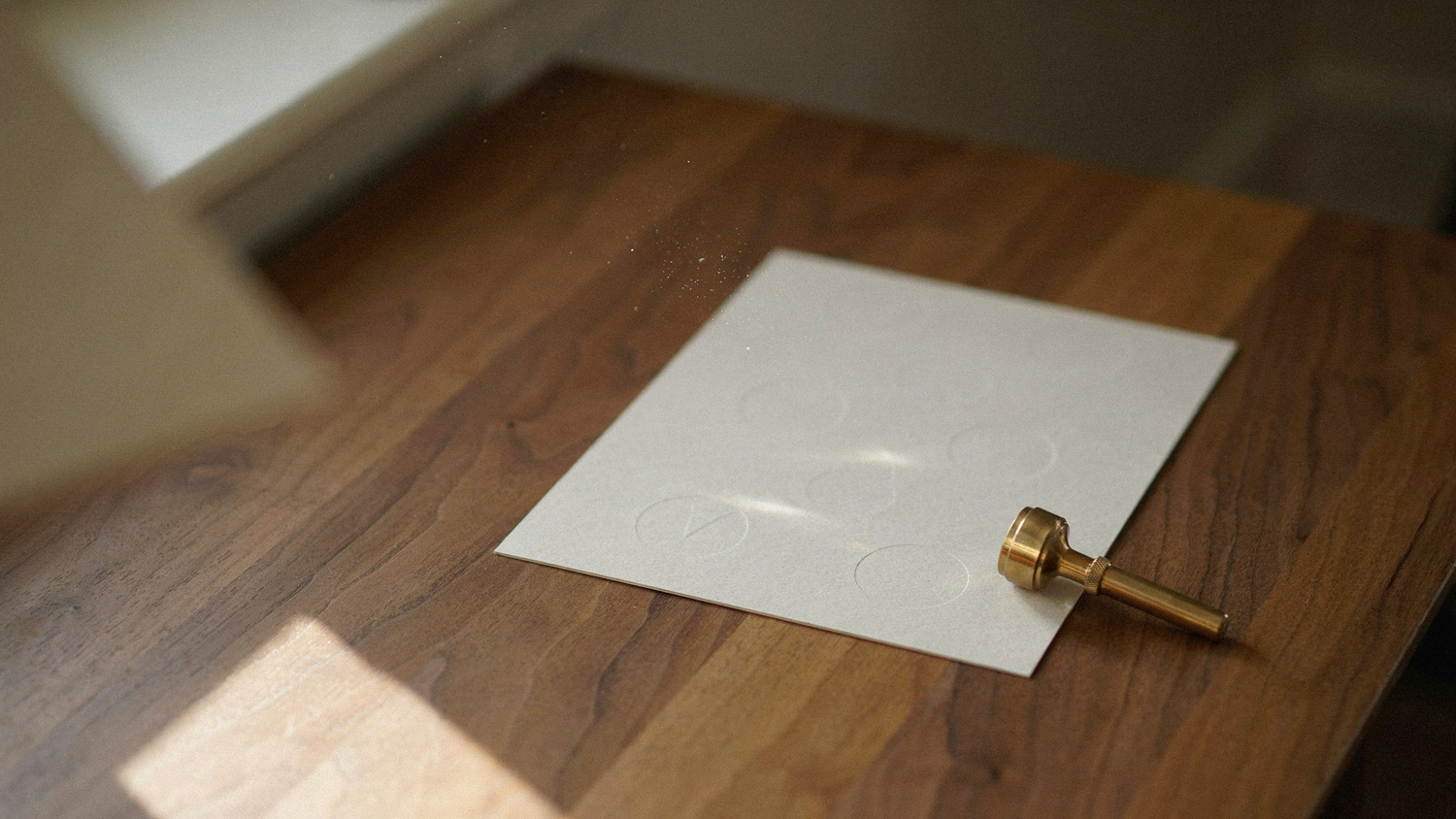
Scratch-and-sniff works by keeping fragrance inside microscopic capsules within a printed coating. When the coated surface is rubbed or pressed, enough capsules break to release their contents into the air. The paper has not absorbed a permanent perfume; it carries a carefully protected, dormant scent until friction gives it a brief opportunity to escape. The effect is simple to experience, yet it sits at the meeting point of print, material science and the surprisingly intimate act of touching a page.
A scent waiting in the surface
At first glance, a scratch-and-sniff card can look ordinary. There may be a patch of colour, a small illustration or a glossy detail that asks to be touched. Its unusual quality is hidden in a coating rather than announced by the paper itself. Rub the marked area and the surface answers with scent.
That answer is temporary. It arrives as a small plume, then fades as the released fragrance disperses. The page remains, but a little of its stored potential has been used. This is part of the charm. Scratch-and-sniff is not a room fragrance trying to fill a space. It is a close-range encounter with a printed object, designed to be noticed for a moment.
The material is often discussed as though the page has somehow learned to smell. In practice, the scent is held in microscopic fragrance-containing capsules, mixed into or applied with a binder on a surface. The binder helps the coating sit on its chosen substrate. The capsules act as small containers. Until they are disturbed, they help keep the fragrance separated from the wider air.
What a microcapsule does
A microcapsule is a tiny enclosed particle with a core and a surrounding wall. In scent applications, the core contains fragrance material. The wall provides a measure of protection while the coating is stored, printed, handled and displayed. Many details can change from one technical system to another: the material used for the wall, the way the coating is applied, the kind of paper or card beneath it, and the fragrance composition itself.
That variation matters. There is no single universal scratch-and-sniff recipe. Some scented print effects use different release methods, and not every fragranced sheet should be described as scratch-and-sniff. The familiar term is best reserved for a surface intended to release scent through rubbing or pressure.
Microencapsulation is a controlled-release approach. Its value is not that it makes fragrance timeless. It helps hold fragrance back until a particular moment of use. In a scratch-and-sniff setting, that moment is created by a fingertip. The action is modest, but it changes the material from something seen into something experienced.
Why rubbing releases the scent
When you rub a coated area, friction and pressure act on the microcapsules. If enough capsule walls rupture, the material inside can leave the coating and become detectable as scent. A hard scratch is not necessarily better. The effect depends on how the coating was designed, how much pressure is applied and how the surface has aged or been handled.
This is why the experience is often described as a reveal rather than an on-off switch. A first rub may release a clear impression. A later rub may be softer because some capsules have already broken. The scent is not being generated by the paper in the moment. It is being released from a limited reserve.
There is a pleasing material logic to it. Print is usually expected to carry visual information: ink, image, type, texture. A fragranced coating adds another layer of instruction. It quietly tells the reader that touch has a consequence. The page becomes interactive without a screen, button or battery.
Binder, substrate and the discipline of the coating
The capsule is only one part of the arrangement. A coating needs a way to stay where it has been placed. That is the binder's role. It helps hold the capsules across the surface of paper, card or another chosen substrate while leaving the intended release action possible.
The substrate matters too. A smooth card can make a coated patch feel precise and deliberate. A more textured stock may change how the coating sits and how a finger moves across it. Printers and material specialists consider practical questions that a reader never sees: how the coating will be applied, whether it will remain intact during production, how it will behave in storage, and how the finished piece should be handled.
These considerations explain why scratch-and-sniff is better understood as a material system than as a novelty ink. It is an agreement between scent, capsule, binder, surface and touch. If one element changes, the result may change with it.
A brief history without a single origin story
Scented print has appeared in many forms, from promotional cards to packaging, magazines and playful educational materials. It is tempting to reduce that history to a neat first invention, but the technology has developed through overlapping work in printing, coatings, encapsulation and fragrance. A single inventor or universal date does not explain the whole field.
What has endured is the appeal of bringing a non-visual sense into a visual medium. A printed page normally asks for attention through words and images. A scented patch adds anticipation. It creates a pause between looking and knowing. Before the surface is touched, the scent is only a possibility.
That possibility explains why scratch-and-sniff has remained useful beyond childhood objects. In a well-made printed piece, scent can become a small editorial detail. It can suggest a material, a place or a mood without attempting to replace the written or visual story.
Why it feels more immediate than an image
Smell does not arrive through the page in the same way as an image. You cannot inspect it from a distance. You have to decide to touch the surface, then lean close enough to notice the result. The object asks for participation, and the response is private. Two people can scratch the same card and still describe the scent differently.
That personal element is one reason the format can be memorable. It does not prove that a scented page creates an accurate or lasting memory, nor does it give a fragrance a fixed meaning. It simply makes scent part of a physical encounter. If you are curious about why an odour can sometimes cue a personal recollection, our guide to why smells trigger memories looks at that question separately.
There is also a quiet contrast between the microscopic scale of the capsules and the scale of the experience. The coating may be almost invisible, but the response can make a flat object feel momentarily alive. That is not magic. It is careful design working at a scale the eye does not register.
What scratch-and-sniff is not
Scratch-and-sniff is not a guarantee that a scent will remain unchanged for years. Fragrance and printed coatings can be affected by time, storage, light, handling and the particular materials involved. Microencapsulation can support retention, but it is not a promise of permanence.
It is also not a reliable way to reproduce a complete product fragrance. A scent experienced from a rubbed patch is shaped by the amount released, the coating, the distance from the surface and the moment of smelling. It may offer an impression, but it should not be treated as an exact stand-in for a fragrance in another format.
Nor is it a home project to improvise from household materials. The making of fragranced coatings involves choices about formulations, handling and print processes. The most useful role for a reader is appreciation: noticing how a familiar object can become more tactile through a layer of hidden engineering.
Where the technique is heading
Printing technology continues to explore ways of applying microencapsulated fragrance coatings with accuracy while preserving the capsules until the intended moment of use. Recent patent activity points to digital application methods as one direction of travel. A patent application is not evidence that a method has become standard across the industry, but it does show that the technical question remains active.
The broader interest is easy to understand. A physical item can offer an experience that asks for time rather than a click. It can make a sample, invitation, package or editorial insert feel considered. The best version is restrained. It lets scent support the material instead of asking the material to carry an entire performance.
For a related perspective on scent as information rather than decoration, see can a machine smell. The question is different, but both subjects show how much sits between a chemical signal and the meaning we give it.
From a printed gesture to a room
Scratch-and-sniff gives fragrance a very specific job: it accompanies a touch. Home fragrance works on a different scale, within rooms that change with light, movement and daily life. The two should not be confused. One is a brief release from a coating; the other is part of a lived atmosphere.
Still, both reward attention to material and context. A fragrance oil may be chosen for the character it lends to a space, while a scent diffuser is chosen for the way it fits into a home. You can explore the two categories through the fragrance oil collection and scent diffuser collection, without assuming that either recreates the intimate mechanics of scented print.
Pip & Wells approaches fragrance as a composed part of a moment and a material. A coated card, a warm-ivory page or a quiet room each invite a different kind of attention. The value is not in making scent perform endlessly. It is in noticing what the right material can hold, then letting the moment remain proportionate.
Your Questions, Answered.
How does scratch-and-sniff work?
Scratch-and-sniff commonly uses fragrance-containing microcapsules in a coating held on a surface by a binder. Rubbing or pressure can rupture some capsules and release fragrance for a brief smell experience.
Are all scented papers scratch-and-sniff?
No. Scented paper can use different materials and release methods. Scratch-and-sniff is best used for surfaces designed to release scent through rubbing or pressure.
Why does the scent become weaker after repeated scratching?
Each scratch can rupture some of the capsules that hold fragrance. Once their contents have been released, that portion of the coating has less fragrance available for a later rub.
Does scratch-and-sniff scent last forever?
No. Microencapsulation can help retain fragrance until use, but it does not make a coating permanent. Storage, handling, time and the particular materials used can all affect the result.
Can a scratch-and-sniff patch match a fragrance exactly?
It can offer an impression, but it should not be assumed to reproduce a fragrance exactly. The release amount, coating and close-range smelling conditions shape what is noticed from the printed surface.
Leave a comment
This site is protected by hCaptcha and the hCaptcha Privacy Policy and Terms of Service apply.