

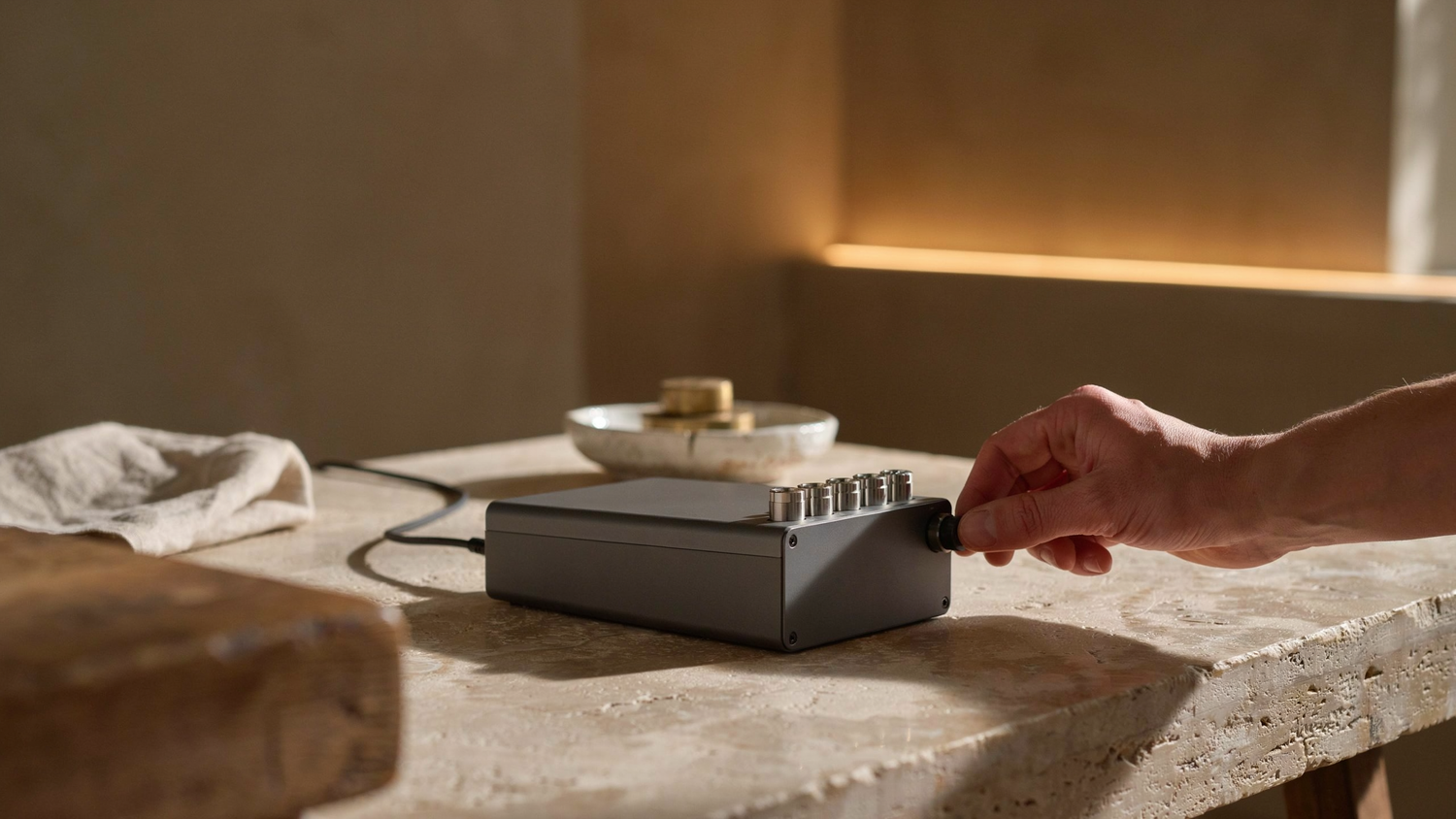
At the boundary of an industrial site, a change in the air can become noticeable long before anyone agrees on what it is, where it came from or how strong it feels. A person may describe the odour as sour, metallic or simply wrong. A sensor has no such vocabulary. It records a pattern.
So, can a machine smell? In a limited but useful sense, yes: an electronic nose can detect and classify chemical patterns associated with particular odours. But it does not experience a smell. It has no memory of rain, no aversion to smoke and no idea whether a room feels inviting. What it offers is not a digital version of the human nose, but a different way of reading volatile chemicals.
That distinction is where the technology becomes interesting.
What an electronic nose actually does
An odour is not a single property floating in the air. It usually arises from a mixture of volatile compounds reaching the nose together. Human olfaction begins when those molecules interact with many types of receptors. The resulting activity is interpreted by the brain alongside context, expectation and previous experience.
An electronic nose borrows the broad logic of distributed sensing without copying the biological system. It typically contains an array of chemical sensors. Each sensor is cross-selective: it may respond to several compounds rather than identifying one molecule with perfect exclusivity. When air reaches the array, the sensors change in different degrees. One signal may rise sharply, another only slightly, while a third remains almost still.
Taken together, those responses form a pattern, often called a fingerprint. Software then compares that pattern with examples collected during training. If the new response resembles a known class closely enough, the system can assign a label or flag a change.
That sequence matters:
- a sample reaches the sensor array;
- several sensors respond;
- the signals are cleaned and combined;
- a trained model compares the pattern with known examples;
- the system reports a classification, estimate or alert.
It is closer to recognising a chord than naming every instrument in an orchestra. The overall arrangement can be distinctive even when the system does not separately identify every molecule that produced it.
A nose built for one question
The phrase “electronic nose” can suggest a universal instrument: point it towards anything and receive the name of the smell. In practice, useful systems are usually designed around a narrower question.
A security team might want to distinguish a defined target signature from background air. An industrial operator may need to detect a change in a recurring emissions pattern. A research team could train a system to separate defined sample groups under controlled conditions. In each case, the sensor array, sampling method, reference data and model are chosen for the task.
This specialisation is a strength. A machine can take repeated measurements under a defined protocol and look for patterns too subtle or monotonous for practical human monitoring.
Yet specialisation is also the boundary. A model trained on a particular set of samples does not automatically understand a new compound, a new mixture or a new environment. Even a familiar odour source can present differently when concentration, airflow or background chemicals change. The machine recognises what its system has been prepared to recognise.
Why it is not a digital human nose
Human smell is not only detection. The brain combines sensory input with memory, attention and meaning. The aroma of wood smoke may signal comfort in one setting and danger in another. A trace of citrus can seem bright in a kitchen but clinical in a corridor. The molecules matter, but they are not the whole experience.
That is why the question “does it smell the same?” becomes difficult. An electronic nose can show that two samples produce similar sensor-response patterns. It cannot establish that a person will experience them in the same way. The difference also explains why smells trigger memories so strongly: perception is connected to a life, not merely a reading.
Laboratory instruments can go further than pattern classification. Gas chromatography can separate components in a mixture, while mass spectrometry can help identify them. These methods offer detailed chemical information, but they still do not recreate subjective perception. An electronic nose can instead be configured for a defined, deployable comparison. It exchanges some analytical detail for a practical pattern-level answer.
One system may therefore be excellent at detecting a known industrial signature while being unable to describe the scent of a rose. That is not a failure of intelligence. It is a consequence of the question the instrument was built to answer.
From the laboratory to an industrial perimeter
The European SENSODOR project shows what task-specific artificial olfaction can look like outside a controlled bench test. The EU-funded work, which ran from 2021 into early 2025, focused on continuous, real-time approaches to detecting and quantifying industrial odours.
According to the project’s reporting, researchers worked with sensing materials including copper oxide, tin oxide and tungsten oxide. The project reported hydrogen sulphide detection at five parts per billion, deployments at five industrial sites, a stationary sensor network and a drone trial. Those figures describe the project’s own results; they are not a promise that every electronic nose will reach the same performance in every setting.
The wider value lies in the measurement model. Odour complaints are difficult to manage when they depend only on occasional observations made after an event. A network that records patterns continuously may help connect changes in the air with time, location and operating conditions. It can provide another layer of evidence, not an automated verdict on what a community should find acceptable.
This creates a second-order question. More measurement can make a problem more visible, but visibility does not decide responsibility by itself. Operators still need transparent thresholds, reliable calibration and a process for investigating alerts. Communities need to know what is being measured and what is not. A number can support a conversation; it should not quietly replace one.
Recording an odour is not preserving an experience
The SMELLODI research project approached digital olfaction from another direction. It combined electronic-nose fingerprints with detailed chemical analysis, work on biomimetic sensors and the language people use for odours. According to its reporting, samples came from more than 100 healthy participants and 70 patients, while a vocabulary study involved around 2,000 people across 21 countries.
That combination is revealing. A chemical fingerprint alone is not a shared language. People and cultures may group, name and interpret smells differently. Building a useful digital system therefore involves both measurement and the difficult work of connecting patterns to human descriptions.
SMELLODI also reported proof-of-principle work on an odour display, limited to a small number of components. The limitation matters. Capturing data about an odour and producing a controlled mixture are significant research steps, but neither proves that an original sensory moment can be copied intact. The same caution applies when asking whether a smell can be preserved. Molecules may be sampled, described or reconstructed; context and personal meaning do not fit inside the file.
The project included medical research contexts, but that should not be confused with a ready diagnostic device. Biological samples are complex, study populations are defined and promising classification results require careful validation. An electronic nose can be a research instrument without being a clinical answer.
The quiet problems: drift, humidity and the unknown
The polished diagram of an electronic nose usually ends at “pattern recognised”. Real systems continue into maintenance.
Chemical sensors can change over time, a problem known as drift. Temperature and humidity can alter responses. Sampling technique affects which compounds reach the array and in what concentration. Complex backgrounds may mask or distort the target pattern. A model may perform well on data collected in one place and less well when moved to another.
Calibration is therefore not a one-off ceremony. Reference samples, cleaning, monitoring and retraining can all form part of the operating life of a system. Data quality matters as much as model sophistication. If the examples used for training are narrow, inconsistent or poorly labelled, the classification boundary will inherit those weaknesses.
There is also the unknown. A confident label can hide the fact that the model was forced to choose the nearest known class. Well-designed systems need a way to express uncertainty or reject an unfamiliar sample. In some settings, “I do not recognise this pattern” is the most responsible result.
These constraints do not make electronic noses unhelpful. They make them instruments rather than oracles. Their reliability comes from the full system: sensors, airflow, reference data, software, calibration and human interpretation.
What machines may change about the way we smell
If electronic noses become more common, their most important effect may not be giving computers a new sense. It may be giving organisations a new record.
Continuous chemical-pattern data could make certain changes easier to trace across hours, locations or batches. That may improve consistency in defined tasks. It may also create pressure to treat every odour question as a measurement problem. Yet the aspects that matter in homes, public spaces and shared environments often include intensity, timing, expectation, consent and association. Those are partly human judgements.
At Pip & Wells, this is why atmosphere is never reduced to a chemical signature. Choosing a fragrance still involves the room, the moment and the person who lives there. Guidance on choosing home fragrance online can provide structure, and the language used for fragrance oils can make comparison easier. Neither replaces perception. A sensor might classify the pattern in the air; only a person can decide what that atmosphere means.
Your Questions, Answered.
Can a machine really smell?
A machine can detect and classify chemical-response patterns associated with odours when it has suitable sensors and training data. It does not consciously experience a smell, so “smell” is useful shorthand rather than proof of perception.
What is an electronic nose?
An electronic nose is a sensing system that combines an array of cross-selective chemical sensors with signal processing and pattern-recognition software. It is usually configured for a defined classification, comparison or monitoring task.
Does an electronic nose identify every chemical in the air?
Not necessarily. Many systems work with the combined response pattern of their sensor array rather than identifying every compound separately. More detailed chemical analysis may require laboratory techniques such as gas chromatography and mass spectrometry.
Can electronic noses diagnose disease?
Electronic noses are being studied in medical research, including work with biological samples. Research findings do not make a device a validated diagnostic tool. Clinical use requires rigorous testing, defined populations, regulatory review and evidence that performance holds outside the original study.
What stops an electronic nose from working reliably?
Performance can be affected by humidity, temperature, sensor drift, sampling conditions, background mixtures, calibration and the quality of training data. Reliable use depends on controlling or monitoring those factors and allowing the system to reject unfamiliar patterns.


Leave a comment
This site is protected by hCaptcha and the hCaptcha Privacy Policy and Terms of Service apply.