

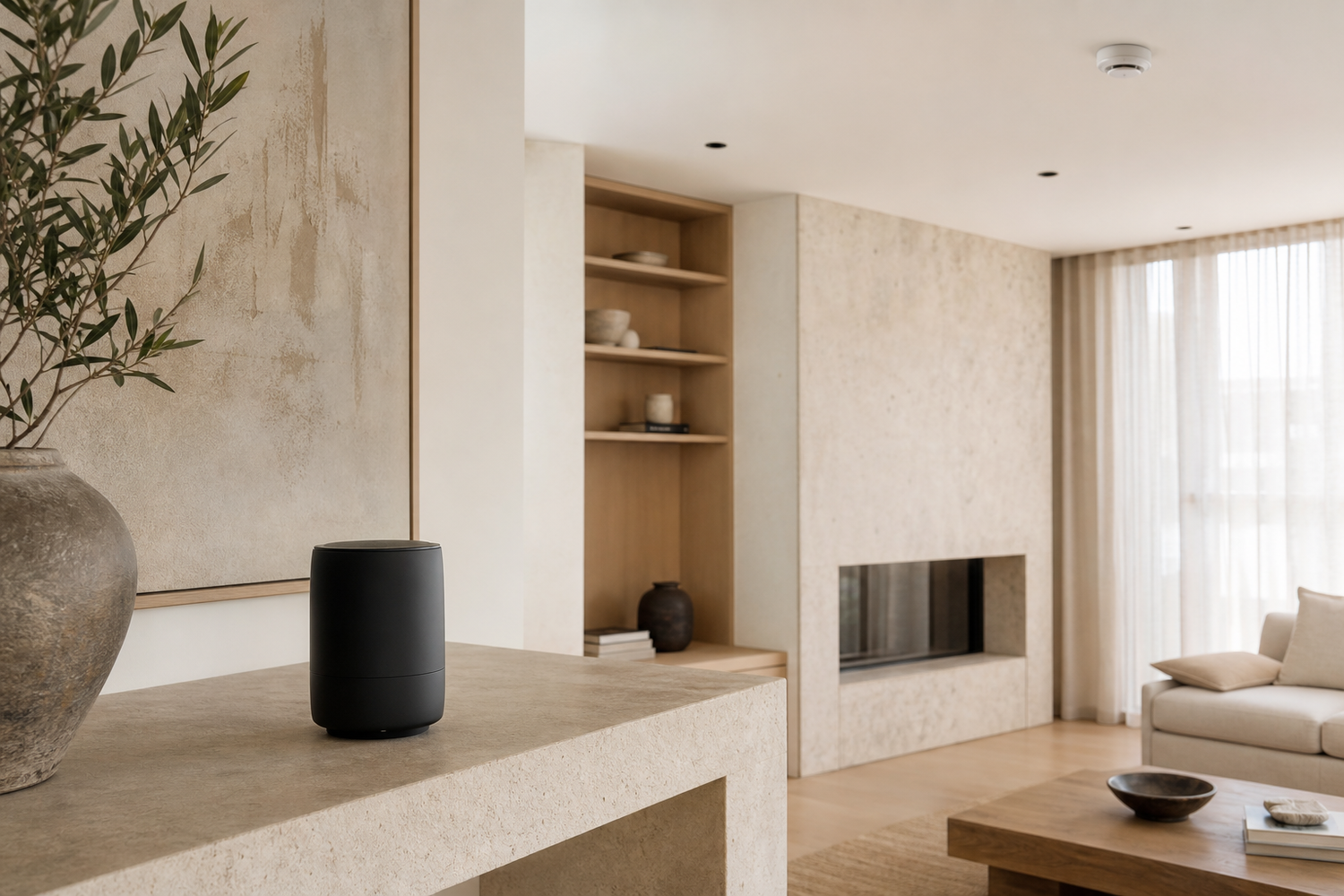
Direct answer: a fragrance diffuser can potentially contribute to an unwanted smoke-alarm activation, although it creates no combustion smoke. Smoke alarms detect airborne particles, and a waterless diffuser disperses very fine fragrance droplets. Whether those droplets influence a particular alarm depends on the detector, concentration, position, airflow and room. There is no universal safe distance and no basis for claiming that the Pure One normally will—or never will—set off a smoke alarm.
If an alarm sounds, treat it as a possible real fire first. Get people to safety and follow the building’s emergency procedure. Never ignore, cover or disable an alarm because a diffuser is running.
Why a diffuser may affect a smoke alarm
The name “smoke alarm” can make it sound as though the device recognises fire itself. In practice, common smoke alarms respond when enough airborne particles enter their sensing chamber.
A photoelectric alarm shines light inside that chamber. Particles can scatter light towards a sensor; when the signal crosses the alarm’s threshold, it sounds. An ionisation alarm measures a small electrical current and responds when particles disrupt it. Multisensor and building-wide systems may combine technologies and decision rules.
Particle size, concentration and detector design all matter. That is why cooking aerosols, dust or steam can sometimes produce an unwanted alarm even without a fire. Manufacturers also warn against spraying air fresheners and other aerosols close to certain alarms.
A waterless diffuser is not a spray can and it does not burn fragrance oil. It atomises a compatible liquid into fine droplets so fragrance can move through the air. The careful conclusion is therefore not “a diffuser causes fire alarms,” but this: a concentrated plume of airborne droplets could influence a susceptible detector in some circumstances.
What to do when an alarm sounds
Do not begin by deciding that the diffuser caused it. An alarm is designed to demand attention, and fragrance in the room does not rule out a real fire.
1. Treat it as real until safety is established
Follow the escape plan or building instructions. Look, listen and smell only as far as you can do so safely; do not search through smoke or delay evacuation. In a hotel, apartment block, workplace or other managed building, follow staff and alarm-system instructions.
2. Leave and call for help when fire cannot be ruled out
If there is smoke, heat, a burning smell, visible fire or any uncertainty, leave the building and contact the emergency services from a safe location. Do not return until the responsible authority says it is safe.
3. Do not disable the alarm
Never remove a battery, cover the detector, disconnect a wired alarm or move it to make diffuser use easier. A nuisance alarm is frustrating; an ineffective alarm is dangerous.
4. Use a silence function only as instructed
After fire has been ruled out, use a hush or silence function only if the alarm manufacturer or building procedure allows it. Do not improvise. Some linked or managed systems must be handled by an authorised person.
5. Stop fragrance use and record what happened
Once it is safe, switch off the diffuser if this can be done normally. Note which alarm sounded, the diffuser position and setting, how long it had been running, whether doors or windows were open, and whether cooking, steam, dust or sprays were present. This record is more useful than assuming one cause.
How to reduce the chance of a repeat
The solution is not to redesign the fire-safety system around the diffuser. Keep the detector installed, powered and maintained as required, then adjust fragrance use within the rules for the room.
Read both sets of instructions
Check the diffuser manual and the exact smoke-alarm instructions. Alarm models differ, and rules for rented or managed property may be stricter than general household advice. Product-specific instructions always take priority.
Keep fragrance output out of the detector’s immediate air path
Do not position a diffuser directly beneath an alarm or aim its outlet towards the detector. Avoid placing it where a fan, vent or strong draught carries the output straight to the alarm. This is a principle, not a measured safe distance: airflow and detector sensitivity vary too much for one number to apply everywhere.
The Pure One waterless scent diffuser has adjustable intensity. Begin with the lowest useful setting rather than trying to fill the room quickly. Its presence here does not mean it has been tested against every smoke-alarm model.
Change one variable at a time
If normal fragrance use is permitted after checking the manuals and building rules, use the lowest useful setting only while the space is occupied. Treat that as a conservative starting point, not as a proven way to prevent an alarm. Do not deliberately test whether the diffuser can activate the alarm. If an unwanted alarm recurs during normal use, stop using the diffuser in that position and contact the alarm manufacturer, landlord, building manager or a qualified fire-safety professional.
Do not keep repeating a test that activates the alarm. Repeated nuisance alarms can disrupt a building and may encourage unsafe behaviour.
Keep the alarm maintained
Dust, insects, age or contamination can affect some detectors. Follow the manufacturer’s approved testing, cleaning and replacement schedule. Do not spray cleaner, air freshener or fragrance onto or near the alarm, and never open its sensing chamber unless the official instructions explicitly require a user-serviceable step.
Homes, hotels and managed buildings need different decisions
In your own home, you may be able to adjust the diffuser setting and choose another permitted location after reading both manuals. You still must not alter required alarm placement or operation.
In a rented home, ask the landlord or building manager when the alarm type, linked system or rules are unclear. In hotels and holiday rentals, assume the installed fire-safety system takes priority. Do not use a personal diffuser unless the property permits it. A room may contain detectors linked to a wider evacuation system, so a “quick test” can affect more people than the person using the diffuser.
In a workplace, care setting or commercial venue, fragrance use and alarm response belong to the responsible person and the site’s fire-safety procedure. Do not independently silence, reset or relocate equipment.
Is a waterless diffuser different from steam?
Yes, but that does not create a universal exemption. A waterless diffuser uses no water reservoir and does not produce steam. It disperses fragrance liquid as fine droplets. A smoke alarm’s response is determined by what reaches its sensing chamber and how that particular detector interprets it—not simply by whether the airborne material is called smoke, steam or fragrance mist.
This also explains why a particle sensor in another appliance may react to fragrance droplets. Our guide to using an air purifier and diffuser together covers that separate question. An air purifier is not a reliable way to prevent a smoke-alarm activation and should not be treated as one.
What this answer does not cover
Smoke alarms, carbon-monoxide alarms, heat detectors and sprinklers do not all use the same trigger. Advice about one should not be transferred to another. If a combined device gives a carbon-monoxide warning, leave and follow its emergency instructions; do not attribute it to fragrance.
This article also cannot determine whether a specific alarm is faulty. Persistent activations need model-specific support or professional assessment. For questions about the Pure One itself, contact Pip & Wells, but alarm placement, testing and building compliance belong with the alarm manufacturer or responsible fire-safety party.
Questions about fragrance use around children or animals need a separate, household-specific assessment. Our guide to waterless diffuser safety around children and pets explains those considerations without treating a smoke alarm as a general safety monitor.
A calm rule to remember
Home fragrance should fit around the safety systems already in the room. Respect the alarm manual, the building procedure and the lowest comfortable fragrance setting. If the two appear to conflict, pause fragrance use and ask the responsible manufacturer or fire-safety party before trying again. Pip & Wells can help with questions about the diffuser; the alarm expert remains the right source for the detector.
Frequently asked questions
Can a waterless diffuser trigger a smoke alarm?
It is technically possible for fine airborne fragrance droplets to influence some smoke detectors when enough reaches the sensing chamber. It is not inevitable, and no evidence establishes that Pure One normally triggers alarms. Detector design, concentration, position and airflow all matter.
How far should a diffuser be from a smoke alarm?
There is no universal evidence-based distance. Follow both product manuals and building rules, and keep the diffuser out of the detector’s immediate air path. Never move a required detector to accommodate a diffuser.
What should I do first if the alarm sounds?
Treat it as a possible fire. Follow the escape plan, leave when fire cannot be ruled out and contact emergency services from safety. Do not assume the diffuser is the cause.
Can I cover the smoke alarm while using a diffuser?
No. Never cover, disconnect, remove or disable a smoke alarm for fragrance use. If activations recur, stop using the diffuser in that location and seek model- or building-specific advice.
Does a waterless diffuser make smoke?
No. It does not burn oil or create combustion smoke. It disperses compatible fragrance liquid as fine droplets, and airborne particles other than fire smoke can sometimes affect a detector.
Can a diffuser set off a carbon-monoxide alarm or sprinkler?
Do not assume these systems behave like a smoke alarm. A carbon-monoxide warning or building-system activation needs its own emergency procedure. Follow the exact device and site instructions rather than attributing it to fragrance.

Leave a comment
This site is protected by hCaptcha and the hCaptcha Privacy Policy and Terms of Service apply.