

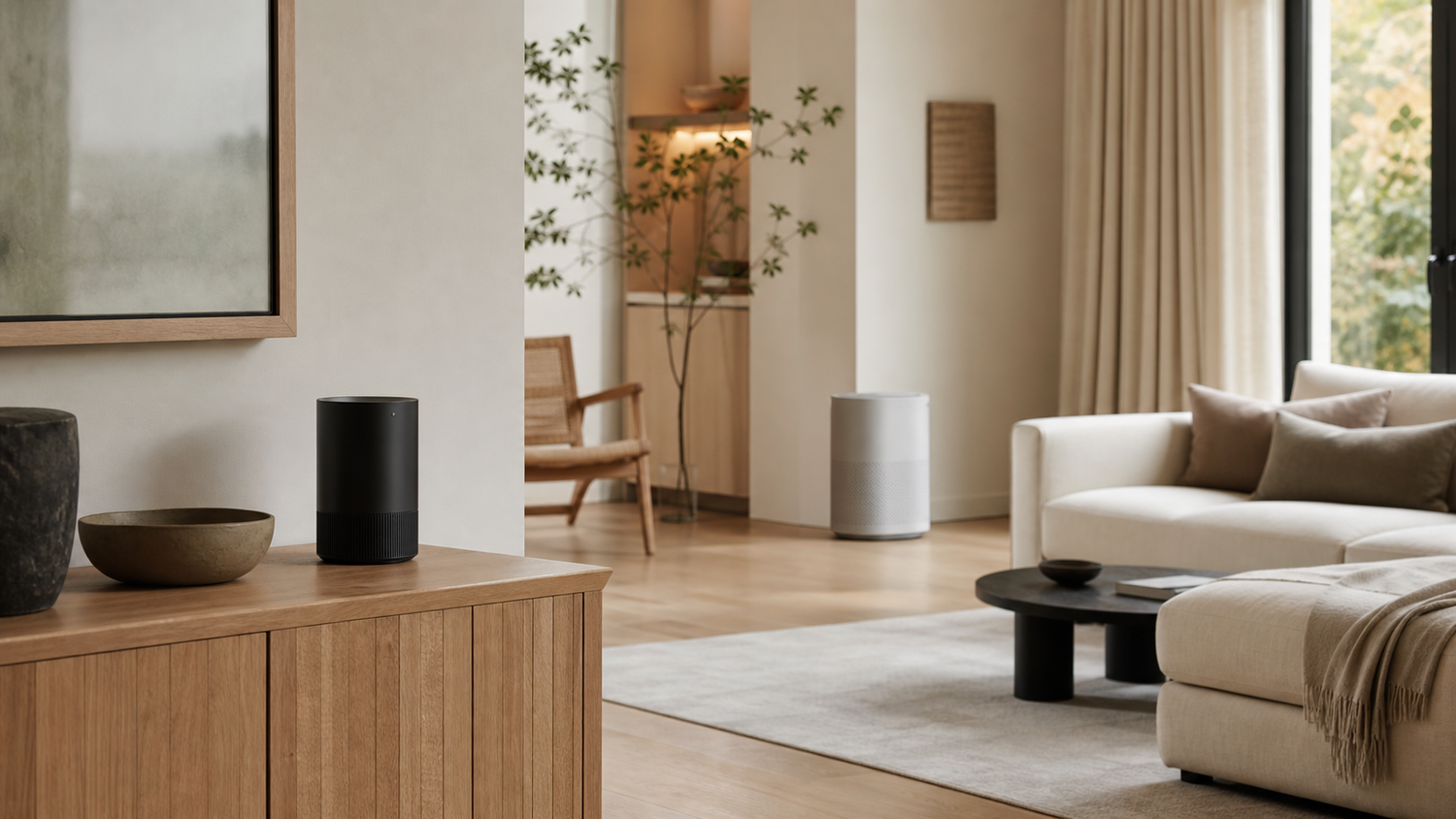
Direct answer: yes, in many homes you can use an air purifier and a waterless scent diffuser at the same time. The two devices simply have different jobs. A diffuser adds a controlled amount of fragrance to the room; an air purifier moves room air through filters. The detail that matters is placement: if you put them side by side, the purifier may capture part of the fragrance close to its source, and its particle sensor may react to the fine fragrance droplets.
The best starting point is simple: follow both manufacturers’ instructions, keep the devices apart, use a low fragrance setting and observe how your own room responds.
First, understand what each device does
An air purifier and a scent diffuser are not opposites, but they are not substitutes either.
An air purifier draws in air and passes it through one or more filters. A particle filter such as HEPA is designed to capture airborne particles. Some purifiers also contain activated carbon or another material intended to adsorb certain gases and odours. The precise result depends on the purifier, its filter combination, fan speed and condition.
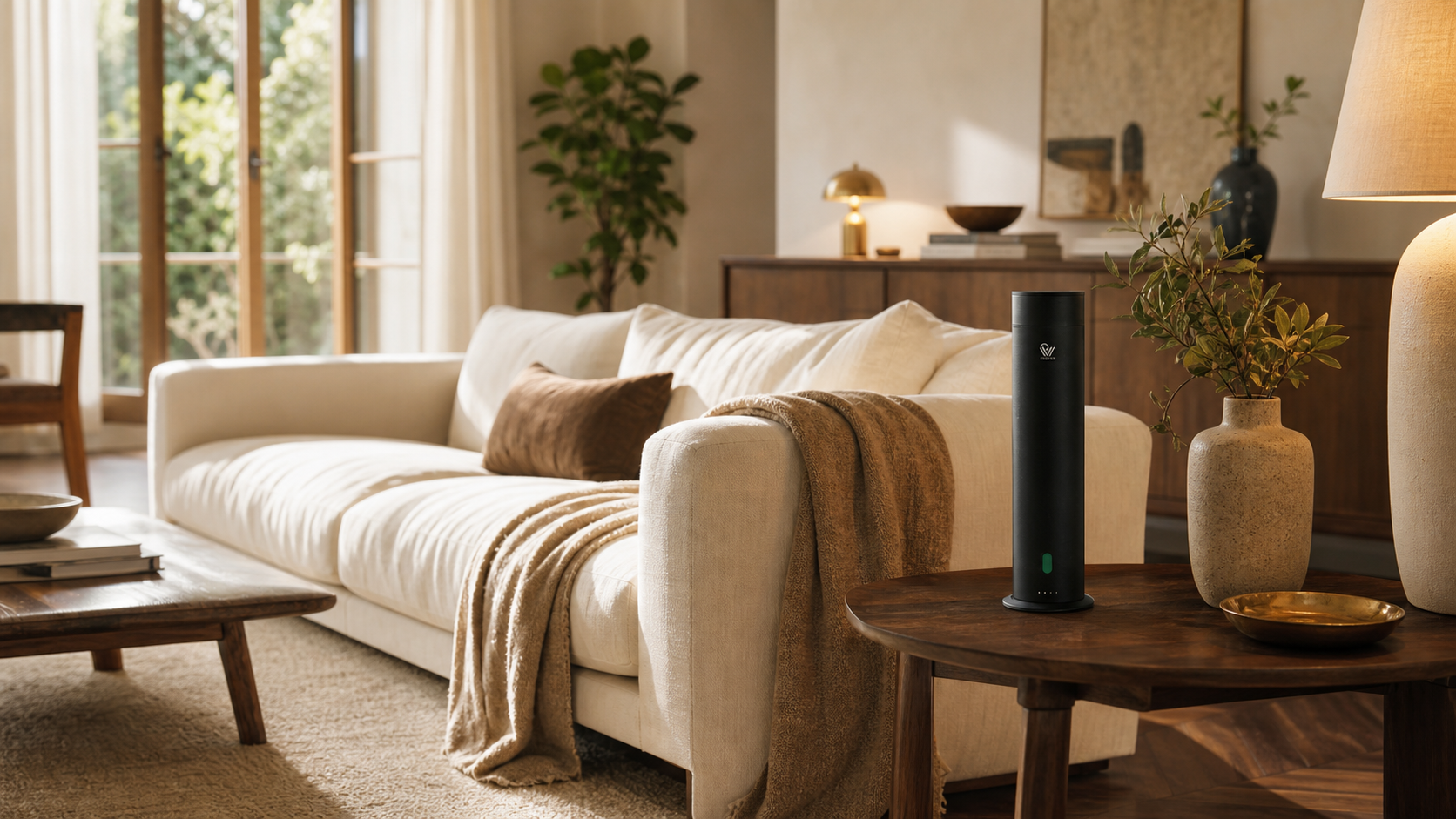
A waterless diffuser has a different purpose. It disperses fragrance oil without a water reservoir. The resulting scent is carried through the room as very fine airborne droplets. It does not clean the air, and it should not be presented as an air-quality device.
That distinction explains why both can run together—and why their airflow can influence one another.
Why can an air purifier react to a diffuser?
Some modern purifiers use an optical sensor to estimate the amount of particulate matter in the air. According to air-purifier manufacturer Blueair, diffused or nebulised aroma oil can form microscopic airborne droplets that scatter the light in such a sensor. The display may then show a higher PM reading, or automatic mode may increase the fan speed.
That reading tells you that the sensor detects airborne material. On its own, it does not identify the exact substance or establish whether the air is safe or unsafe. Sensors, filters and algorithms also differ by model, so the manual for your purifier remains the most relevant source for its behaviour.
If the reading rises as soon as the diffuser starts and falls after it stops, the diffuser may be the trigger. Treat that as a useful setup clue rather than as a diagnosis.
Will an air purifier remove the fragrance?
It can reduce some of it, but there is no universal yes-or-no result.
- A particle filter may capture some airborne fragrance droplets.
- Activated carbon or other sorbent media may reduce some gaseous odour compounds.
- A higher fan speed moves more room air through the filters and may make the effect more noticeable.
- A saturated or unsuitable filter may behave differently from a fresh filter designed for that pollutant type.
The closer the purifier intake is to the diffuser’s output, the more likely it is that part of the fragrance will be drawn into the purifier before it disperses through the room. This is why placing the devices directly beside each other usually works against the purpose of the diffuser.
If your scent seems to disappear quickly even without a purifier, airflow and fragrance habits can also affect how long your home smells good.
A practical setup for using both together
There is no single correct distance for every home. Room size, doors, ventilation, fan speed, purifier intake direction and diffuser output all change the airflow. Use this controlled setup instead.
1. Check both manuals
Confirm that each device can be used in the intended room and follow its placement, clearance, oil and ventilation instructions. Product-specific instructions take priority over general advice.
2. Give each device its own zone
Do not place the diffuser directly next to, on top of or immediately in front of the purifier’s intake. Start with the devices on different pieces of furniture or in different parts of the room, with clear airflow around both. Keep fragrance mist away from walls, textiles and delicate surfaces, following the diffuser instructions.
3. Begin with the lowest useful intensity
More output is not automatically better. Start low and give the fragrance time to circulate before making an adjustment. A waterless diffuser with adjustable intensity makes this easier to test without flooding the room with scent.
4. Test one variable at a time
Run the purifier under its usual setting first. Note the air-quality reading and fan behaviour. Then switch on the diffuser at low intensity without changing anything else. Observe the room for a while.
If the purifier immediately accelerates or the fragrance disappears near the intake, move the diffuser farther away or change its position across the airflow. If the scent becomes too strong, lower the diffuser output rather than switching off the purifier as a first response.
5. Ventilate appropriately
An air purifier is not a replacement for fresh-air ventilation or source control. Ventilate as appropriate for the room and local outdoor conditions. If anyone experiences discomfort—such as headache, coughing, eye or throat irritation—stop the fragrance, air the room and reconsider its use.
Three common situations and what to do
The purifier switches to high speed
An automatic purifier may be responding to the diffuser’s airborne droplets. Check whether the change consistently begins and ends with diffuser use. Increase the separation, reduce diffuser intensity and consult the purifier manual for its sensor guidance. Do not assume that a PM number alone identifies toxicity.
You can barely smell the fragrance
First make sure the purifier is not drawing in the diffuser output immediately. Move the diffuser out of the direct intake path and wait before raising its intensity. Also check open doors, extractors and strong cross-draughts. The goal is balanced circulation, not maximum output.
If you are still deciding which format suits the room, our guide to choosing the right type of scent diffuser explains the main options.
The room feels over-scented
Turn the diffuser down or off and ventilate. If you have been in the room for a while, ask someone entering whether the intensity feels comfortable; their impression may differ from yours. A subtle background presence is usually more comfortable than a concentrated cloud.
Should the purifier and diffuser run on the same schedule?
They can, but they do not have to. A low, intermittent diffuser setting may be sufficient in a regularly used living area, while a purifier may follow its own automatic or continuous programme. The right schedule depends on the two devices and how the room is occupied.
Avoid solving every issue with longer runtime. If the purifier keeps racing, the scent disappears immediately or the room becomes intense, adjust placement and output before extending the schedule. Aim for a setup in which neither device has to compensate for the other.
This also fits a broader principle of sensory interior design: scent works best when it supports a space rather than competing for attention.
When should you not use them together?
Pause and seek more specific advice when:
- either manufacturer warns against the combination or intended placement;
- fragrance causes discomfort for anyone in the room;
- a household member has a respiratory condition, fragrance sensitivity or another health concern;
- you are unsure whether a particular oil is compatible with the diffuser;
- the purifier shows a persistent warning that its manual says requires action;
- local ventilation is inadequate for the intended use.
Homes with children, pets or other sensitive occupants need individual consideration. “Natural” does not automatically mean suitable for everyone, and an air purifier does not provide a universal safety guarantee.
The balanced answer
An air purifier and a waterless diffuser can usually share a room because they serve different purposes. The purifier filters the air it draws in; the diffuser adds fragrance. Problems are most likely when their airflow paths collide: the purifier may capture fragrance near the source, and a particle sensor may interpret fine fragrance droplets as a higher particle load.
Keep the devices apart, start with low fragrance output, follow both manuals and change one variable at a time. That gives you the best chance of maintaining the purifier’s function while creating a scent that feels present, not overpowering.
Frequently asked questions
Can a diffuser make an air purifier’s PM2.5 reading go up?
Yes. Some optical PM sensors can detect the microscopic droplets produced when fragrance oil is diffused. The reading shows that the sensor detects airborne material; it does not by itself tell you exactly what the material is or whether it is harmful.
Should I put a diffuser next to an air purifier?
Usually not. Direct side-by-side placement can cause the purifier to draw in fragrance before it disperses and may trigger its particle sensor. Give both devices clear airflow and separate positions.
Does a HEPA filter remove fragrance?
HEPA filters are designed for particles, so they may capture some airborne fragrance droplets. Gaseous odour compounds require different filter media, commonly activated carbon or another sorbent. Performance depends on the purifier and filter condition.
Can an air purifier make fragrance oil safe?
No. A purifier is not a universal safeguard for fragrance use. Follow the oil and diffuser instructions, consider individual sensitivities, ventilate appropriately and stop use if discomfort occurs.
Is a waterless diffuser also an air purifier?
No. A waterless scent diffuser disperses fragrance oil without a water reservoir. Its purpose is scent, not air cleaning.
Leave a comment
This site is protected by hCaptcha and the hCaptcha Privacy Policy and Terms of Service apply.