

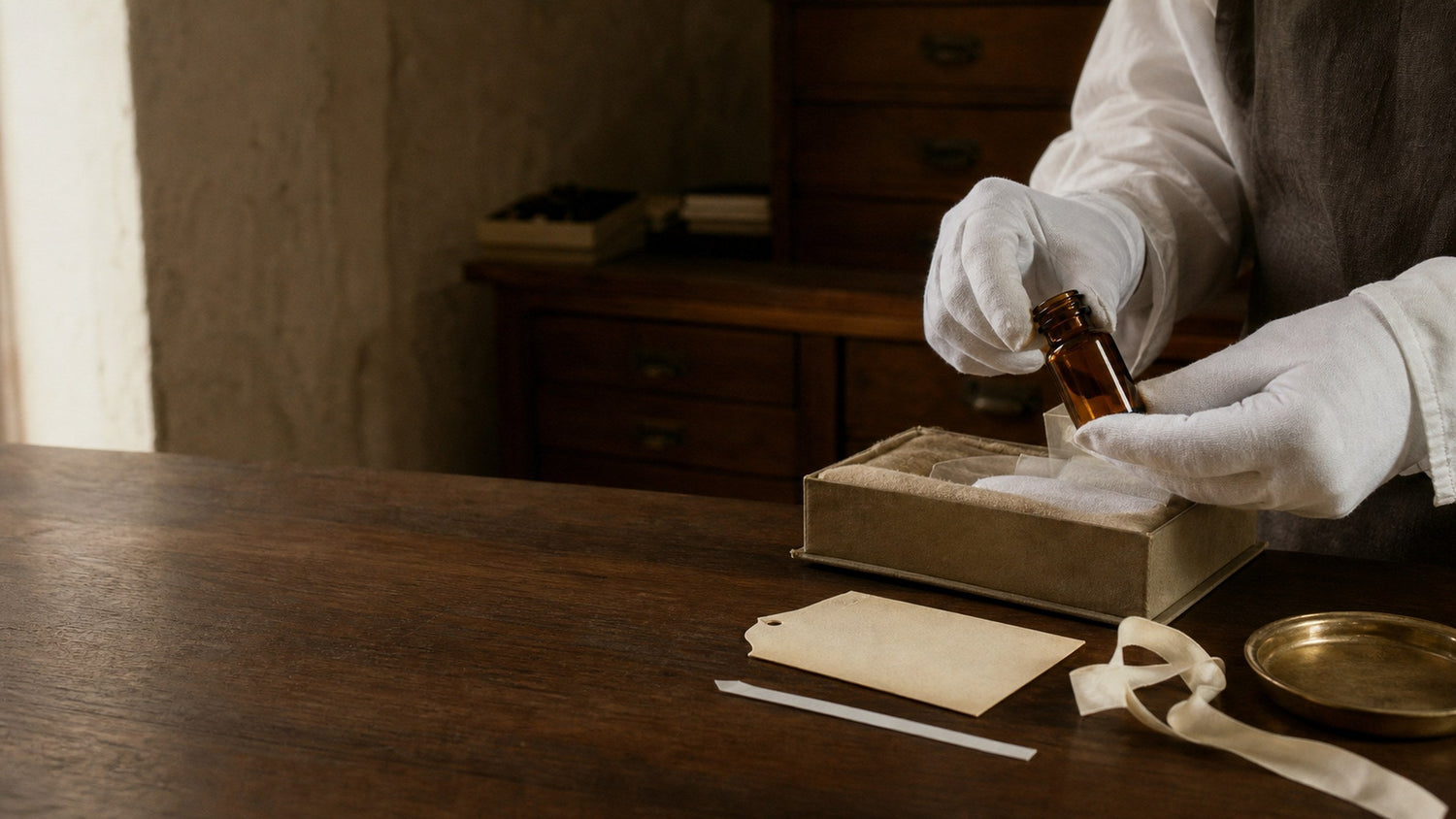
A smell can be preserved only in parts. A sealed sample may retain some volatile material; a formula can record proportions; analysis can map molecules; and human descriptions can capture perceived character and cultural meaning. None of these, alone or together, freezes a past experience intact. Materials age, noses differ and the setting in which a smell once mattered may have vanished.
Museums and perfume archives therefore do something more careful than bottling time: they preserve evidence from several directions, state what has been inferred and distinguish an original sample from a later reconstruction. The archive is not the smell itself. It is the most responsible route back towards it.
The apparently empty case
Imagine a museum display containing no portrait, tool or jewel. There is only a small glass vial, held upright in a fitted support. It looks almost empty.
Yet the space above the liquid is active. Molecules leave the material, enter the air and disappear each time the vessel is opened. Light, oxygen, heat and time alter what remains. The object is present, but part of it is always trying to escape.
This is the central difficulty of a smell archive. Paint adheres to canvas. Words can be copied. A chair can survive centuries with repairs. Odour is an event between a source, the surrounding air and a perceiving person. To archive it, institutions must first decide what, exactly, they mean to keep.
What are we preserving?
The question has at least four answers. Confusing them produces confident but misleading claims about bringing the past back to life.
The material
A fragrance concentrate, a piece of leather, a book or the interior of a vehicle can be retained as a physical object. The material is valuable evidence, but it does not remain chemically static. Even carefully stored perfume changes. A physical sample is therefore not a permanent pause button; it is an ageing witness.
The volatile molecules
Researchers can sample compounds released into the air around an object. That chemical profile helps identify which volatile substances are present and in what pattern. It can support comparison or reconstruction. It cannot record the whole encounter. Concentration, temperature, airflow and the material itself all affect what reaches a nose.
The sensory description
People can describe what they perceive: perhaps dusty, sweet, acidic, leathery or woody. Such language gives evidence that an instrument cannot supply by itself. It also introduces variation. Vocabulary is learned, associations are culturally situated, and two assessors may organise the same sensation differently.
In a 2017 historic-book study, Cecilia Bembibre and Matija Strlič combined sampling of volatile organic compounds with sensory assessment and visitor descriptions. Their Historic Book Odour Wheel organised recurring terms. It was a way to document evidence, not a device for sealing one universal “old book smell”.
The context
An odour’s significance may depend on a practice, place or period. Incense in a ritual, coal smoke in an industrial city and a formula held by a perfume house are not merely molecular inventories. Their meanings come from who encountered them, under what conditions and with what consequences.
Odeuropa’s work treats olfactory heritage through practices, objects, attributes of artefacts and smellscapes. In that framing, a smellscape includes both odours and their cultural meanings. Preserving a list of compounds while losing that setting would retain evidence, but not the entire heritage.
Four ways to keep hold of the fleeting
No single method solves the problem. The strongest archives assemble different kinds of record and allow their limits to remain visible.
1. Formulas, recipes and production records
A formula can preserve instructions: materials, proportions and sometimes procedures. Production records may show when a fragrance was made or altered. For perfumes, this paper trail can be more stable than the liquid itself.
But a formula is not a finished smell. Raw materials can disappear, change in specification or become unavailable. Processes and suppliers matter. Even a precise recipe belongs to a particular material world.
The Osmothèque, a nonprofit institution opened in 1990, describes itself as a perfume archive. Its collection page currently lists 4,000 perfumes, including 800 no longer commercially available. It receives formulas in trust rather than making them public. Crucially, it says a discontinued perfume is remade only when the original formula can be respected rigorously. If necessary raw materials are unavailable, it does not reconstitute it. Restraint is part of the archival method.
2. Physical samples under controlled conditions
Keeping an original sample preserves direct material evidence. Storage can slow change by limiting some of the forces that accelerate it.
The Osmothèque states that its collection is kept away from daylight at a constant 12°C, protected by an inert layer of argon and assessed regularly. Those measures manage deterioration; they do not abolish chemistry or make a liquid immortal.
This distinction matters. “Preserved” can sound complete and final. In conservation, it often means that change has been slowed, monitored and documented. The archive may also retain enough reference material for future study without promising that every opening will reveal precisely what a perfumer encountered decades earlier.
3. Chemical and sensory analysis
Instruments can separate and identify volatile compounds around an object. Sensory panels can then record how a resulting profile is perceived. Together, these approaches create a richer account than either could provide alone.
Odeuropa’s study of a historic Royal Car P5B interior used headspace gas chromatography–mass spectrometry, gas chromatography–olfactometry and sensory panels. Chemical and sensory data then informed a reconstruction used to test the method.
The careful word is “informed”. A reconstruction built from analytical evidence is not the original car interior, nor proof of how every passenger experienced it. It is a reasoned, testable interpretation based on documented traces.
4. Testimony, language, objects and practices
Sometimes little or no original scented material survives. Diaries, catalogues, recipes, oral accounts, artworks, packaging and the tools used in a practice can still establish what a smell was called, where it occurred and why people noticed it.
This kind of documentation can feel indirect, yet it prevents an odour from becoming a free-floating special effect. It records disagreement as well as recognition. A tannery may signify work to one community, pollution to another and nostalgia to someone looking back from a cleaner distance.
The open Olfactory Heritage Toolkit was created to help heritage professionals recognise, document and safeguard such heritage. Its existence signals a broader shift: smell is being treated not as decorative atmosphere, but as something that can carry historical evidence.
Two reconstructions, two kinds of fidelity
At the Osmothèque, the controlling reference is the entrusted perfume formula. A discontinued fragrance may be remade when that formula and its materials can be respected. Here, fidelity is tied to a documented composition and to the institution’s refusal to fill gaps casually.
Odeuropa’s Heritage Smell Library works across a different field. Its first collection, assembled in 2023, contained 19 scents along with physical samples and documentation about their reconstruction and cultural significance. It explicitly distinguishes reconstructions based on chemical analysis from recreations developed from historical recipes or wider historical research. Samples are entrusted to the Osmothèque for future reference or heritage use.
That vocabulary is useful. To document is to record evidence. To preserve is to retain and manage material or information. To reconstruct is to build from analytical traces. To recreate is to interpret from recipes and historical research. The results may all be valuable, but they do not make the same claim.
Who decides what deserves to survive?
Every archive is also a selection. Institutions decide what enters, how it is named, whose description becomes searchable and which absences are acknowledged.
That can favour prestige. A famous perfume formula fits established ideas of authorship and value more easily than the everyday smells of cleaning, cooking, industry or communal labour. Yet ordinary smellscapes may reveal just as much about class, technology, migration and changing ideas of cleanliness.
Selection also raises uncomfortable questions. Some historical scents were connected to extraction, dangerous work, animal materials or unequal trade. Recreating them as a charming sensory encounter can remove the conditions that produced them. Responsible interpretation must retain those histories rather than polishing them into atmosphere.
There is no neutral list of smells that “count”. A good olfactory archive therefore preserves its own reasoning too: why a smell was chosen, whose evidence shaped it, what could not be recovered and where uncertainty remains.
Nor does inclusion end the argument. A catalogue category can flatten local names; a neat description can conceal disagreement; a sensory demonstration can privilege the curator’s chosen version. Recording alternative terms, limits and decisions does not weaken an archive. It shows future readers where evidence ends and interpretation begins, which is essential when the subject cannot be placed before them as a stable object. That transparency lets later custodians revisit choices instead of inheriting them as facts.
An archive is not a freezer for time
Can a smell be preserved? Material can be conserved. Formulas can be guarded. Molecules can be measured. Perceptions can be described, and cultural settings can be researched. Together, these records can support a careful encounter with what might otherwise disappear.
What they cannot do is cancel ageing, restore every missing ingredient or reproduce the exact relation between a past place and the people who knew it. The best scent archives do not hide that limit. They make it legible.
The almost-empty vial in the museum case is therefore not an empty promise. It is one fragment among several: substance, analysis, testimony and context. The archive does not conquer evaporation. It gives the fleeting a documented afterlife.
What a modern fragrance can — and cannot — hold
That same distinction matters in a modern domestic setting. Pip & Wells approaches hotel scent, choosing a home fragrance online, fragrance oils and waterless aroma diffusers as ways of composing a room now. They can make an atmosphere recognisable, but they do not preserve — or recover — a lost historical experience.
Your Questions, Answered.
Can a smell be stored in a bottle forever?
No. A sealed bottle can retain scented material and slow exposure, but its contents may still change over time. Controlled storage manages deterioration rather than stopping it completely.
What is the difference between preserving and reconstructing a smell?
Preserving retains existing material or records under managed conditions. Reconstructing creates a new reference from evidence such as chemical analysis. The reconstruction is an interpretation of evidence, not the original experience returned intact.
How do museums document a smell when no sample survives?
They can use recipes, production records, written descriptions, oral testimony, images, related objects and evidence about the practices or places in which the smell occurred. The result documents historical context without pretending that the missing material has survived.
Can chemical analysis capture exactly what people smell?
No. Analysis can identify volatile compounds and patterns, while sensory assessment records perception. Both are useful and complementary, but neither alone captures the complete experience or its cultural meaning.
What is olfactory heritage?
Olfactory heritage concerns smells considered culturally significant, together with the objects, practices, places and meanings connected to them. It is not a fixed universal list; recognising it involves research, selection and interpretation.

Leave a comment
This site is protected by hCaptcha and the hCaptcha Privacy Policy and Terms of Service apply.