

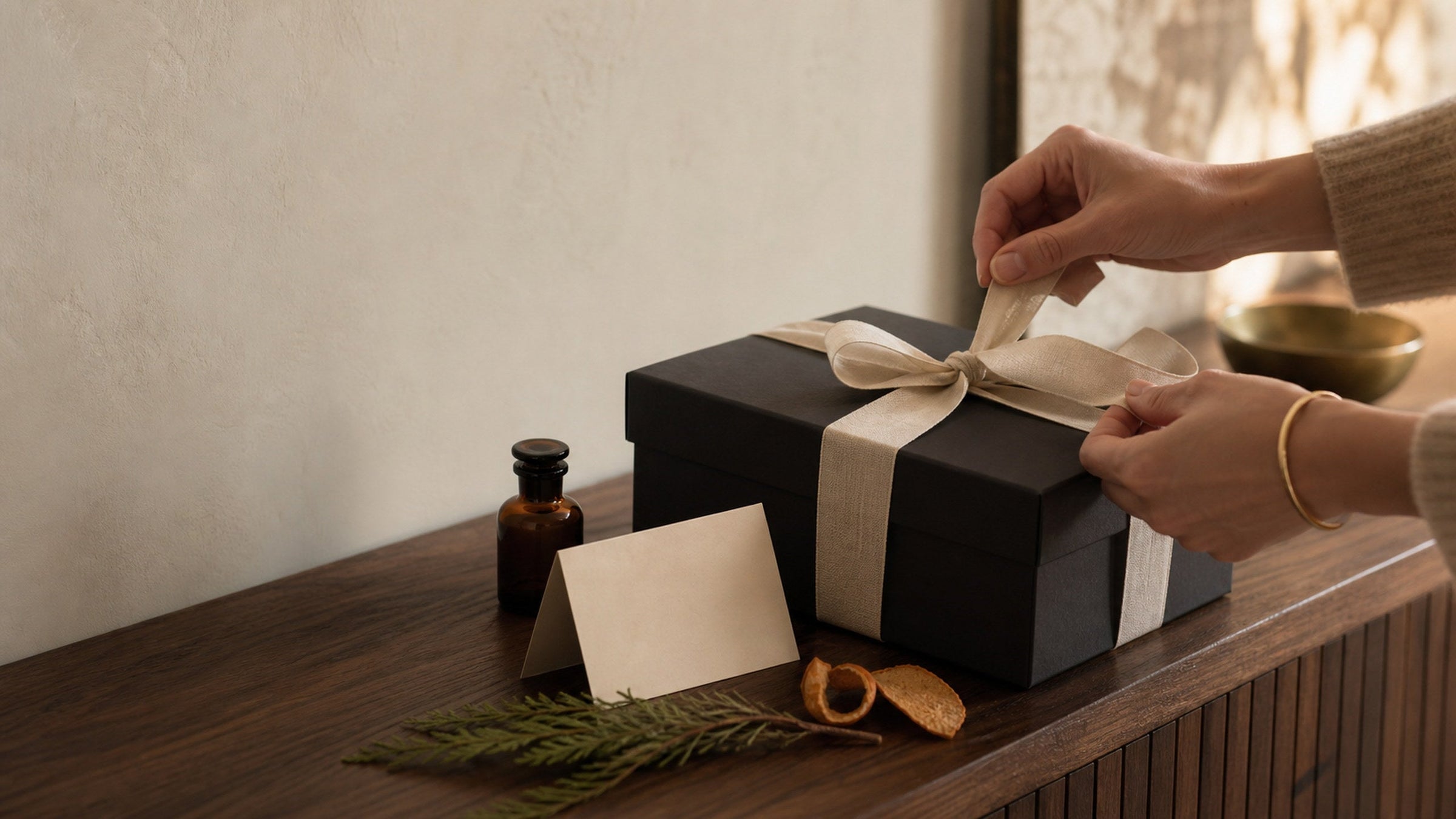
Choosing home fragrance as a gift begins with what you genuinely know about the recipient, not with the scent you would choose for yourself. If you know their exact refill, replace it. If you know their routine and home but not their fragrance, choose a format that gives them some control. If you know very little, preserve the most choice: ask, offer a selection, or choose something unscented. A thoughtful gift does not have to be a perfect surprise. It has to respect the person who will live with it.
That sounds simple. Yet scent is unusually intimate. A vase can sit quietly in a corner; fragrance changes the air of an entire room. It reaches other people in the household, becomes part of daily routines and may demand a device, refills or cleaning. The elegant question is therefore not, “Which scent is safest?” It is, “How much evidence do I have, and how much choice should the gift leave open?”
Choosing for another person is a different task
When buying for your own home, you can follow curiosity. You know whether you enjoy a noticeable presence or something discreet, how often you will use it and which rooms feel right. Our guide to choosing home fragrance online covers that self-directed process.
A gift reverses the perspective. Your own preferences become weak evidence. The recipient may admire your warm, woody home and still prefer something lighter in theirs. They may love fragrance but already own a device that accepts a particular refill. Or they may simply not want scent in a shared space.
This is why personality shorthand is so unreliable. “Minimalists like clean scents” and “confident people prefer intense scents” sound useful because they remove doubt. They do not describe what is in someone’s cupboard, what their household accepts or what they actually use. Observe behaviour instead of inventing a fragrance personality.
The three-level knowledge test
Before browsing, place yourself honestly in one of three levels.
Level 1: you know the exact product
Perhaps you have seen the bottle beside their diffuser, they sent you a link, or they named the fragrance they are about to finish. This is the strongest kind of evidence. Match the brand, product name, volume and device compatibility precisely. A requested or repeated item can be deeply considerate: it shows that you listened and removes the burden of exchanging an almost-right alternative.
Do not “upgrade” the fragrance according to your own taste. If the familiar item is unavailable, ask whether they would like to choose a substitute.
Level 2: you know their home and routine
You have useful clues, but not an exact answer. You may know that they already use home fragrance, prefer switching scents, enjoy adjusting intensity, or have space for a discreet device. Here, choose the format first and leave room within it for discovery.
A selection can make sense when the recipient already has a compatible diffuser and enjoys trying different oils. A complete system may suit someone who has clearly expressed interest in one and is comfortable operating and refilling it. Neither is automatically the safer gift; the right choice depends on evidence.
Level 3: you know almost nothing
This is where restraint becomes part of good gifting. A striking candle on a shelf or a scented hallway during one visit is not enough to infer a lasting preference. Ask a simple question, invite them to choose, or give a non-scented object instead. Uncertainty is not a problem to hide with confident packaging.
The less you know, the more reversible the decision should be. Choice can be built into the gift through a shortlist, a shared shopping moment or a clear invitation to exchange it without awkwardness.
Choose the format before the fragrance
Fragrance names attract attention, but practical fit decides whether the gift will be used.
An existing refill is the clearest route. Check the device and the bottle itself. Oils are not interchangeable merely because their volumes look similar. Confirm the intended product and, if relevant, the size. If you know the recipient uses a Pure One and likes exploring, the fragrance oil collection offers the relevant format without turning your guess into a claim about their taste.
A complete system creates a new routine. It is more than a decorative object. The recipient needs to want a device, have a suitable place for it and feel comfortable adjusting and refilling it. Consider the finish, available surface space and how the household uses fragrance. Give a complete system only when those signals are present.
A selection of oils preserves some choice, but not all choice. It still assumes the recipient owns a compatible device and wants fragrance. Variety does not make a gift universally suitable.
No scented gift is sometimes the most attentive option. If sensitivity, household agreement, pet-related caution or basic interest is unknown, pause. You do not need to diagnose or investigate anyone’s health. A direct question or an unscented gift respects boundaries without making the moment clinical.
Read the home, not the personality
Useful signals are specific and observable:
- the exact diffuser or refill already in use;
- unopened versus frequently replaced bottles;
- whether fragrance appears in shared rooms or only a private space;
- a stated preference for subtle or more present scent;
- an existing habit of changing fragrances;
- black, silver, brass or another repeated finish in visible objects;
- comments such as “I am nearly out” or “I have been looking for a diffuser”.
Weak signals include clothing colour, star sign, job title, age and broad labels such as adventurous or traditional. Even interior style should guide presentation or device finish more readily than fragrance. A room with black metal details may support a matte black object; it does not prove an affection for leather, oud or woods.
A compact decision table
| What you know | Best next move | What to avoid |
|---|---|---|
| Exact fragrance and compatible format | Replace the same item | Substituting your favourite |
| Compatible device, but no exact scent | Offer a considered selection or ask | Calling one oil universally safe |
| Clear interest in a new system | Check finish, placement and upkeep | Treating the device as decoration only |
| Home clues, but no fragrance habit | Ask one light, direct question | Reading taste from décor alone |
| Sensitivity or household acceptance is unclear | Choose unscented or let them decide | Assuming variety solves the uncertainty |
Let the occasion shape the gesture
The occasion can guide scale and presentation without deciding the scent. A housewarming gift may acknowledge a new space, but a new home is also unsettled: the recipient may not yet know where a diffuser belongs. A birthday allows more personal consultation. A thank-you gift can be modest and precise. For a shared household, address the gift to the home only if the people who live there welcome fragrance.
Presentation should explain the choice rather than exaggerate certainty. Add a short note: “I remembered you use this one,” or, “I thought the finish would sit beautifully with the details in your living room; please choose another if you prefer.” That sentence turns exchangeability into care, not failure.
Avoid making the gift dependent on a season unless the recipient has asked for that. A well-chosen format can remain useful beyond a holiday, anniversary or move. It is the relevance of the observation, not the size of the box, that gives the present weight.
A final check before you wrap it
Can you name the evidence behind the format? Have you confirmed compatibility? Does everyone affected by the scent appear comfortable with it? Is upkeep realistic? Have you made exchange or choice feel easy? If one answer is no, step back a level.
Home fragrance can be a generous gift because it becomes part of ordinary life. That is also why it deserves care. Begin with evidence, preserve choice where knowledge ends, and let the recipient’s real habits carry more weight than your imagined version of their taste.
When a Pip & Wells set fits the evidence
Once the earlier questions point towards a complete waterless system, Pip & Wells gift sets offer a Pure One diffuser with three 120 ml fragrance oils. The set creates room to explore, but it should not be presented as a guaranteed match. The recipient still needs to want home fragrance and a refillable diffuser.
Choose the exterior finish from something you can actually see. The Pure One Gift Set in matte black can echo black lighting, frames or hardware. The Pure One Gift Set in matte silver can sit naturally among cooler metal details. These are interior observations, not personality judgements.
If the evidence points only to an existing compatible device, the fragrance oil collection may offer the more proportionate choice. If it points nowhere, ask. The most refined gift is often the one that leaves the recipient feeling understood rather than tested.
Frequently asked questions
Is home fragrance a good gift when I do not know their taste?
Only if the gift preserves choice. Ask what they use, offer a shortlist, or shop together. When interest, sensitivity or household acceptance is unknown, an unscented gift can be the more thoughtful option.
Should I choose a fragrance based on their personality?
No. Personality-to-scent rules are stereotypes, not reliable evidence. Look for an exact refill, an existing device, stated preferences and real usage habits. Use visible interior finishes for the appearance of a device, not to diagnose fragrance taste.
Is a gift set safer than choosing one fragrance?
Not automatically. A set offers variety, but it still assumes that the recipient wants scented products and can use the included format. Confirm those basics first; variety should expand a suitable choice, not disguise uncertainty.
Can I give fragrance oil without a diffuser?
First confirm how the oil is intended to be used and whether the recipient owns a compatible diffuser. Matching by bottle size or appearance is not enough. If compatibility is unclear, ask or choose a complete system only when they have expressed interest in one.
Does asking what they want make the gift less thoughtful?
No. A direct question can show attention and prevent the recipient from managing an unsuitable surprise. You can keep the gesture warm by asking for two or three options, remembering an exact refill, or choosing the presentation yourself.