

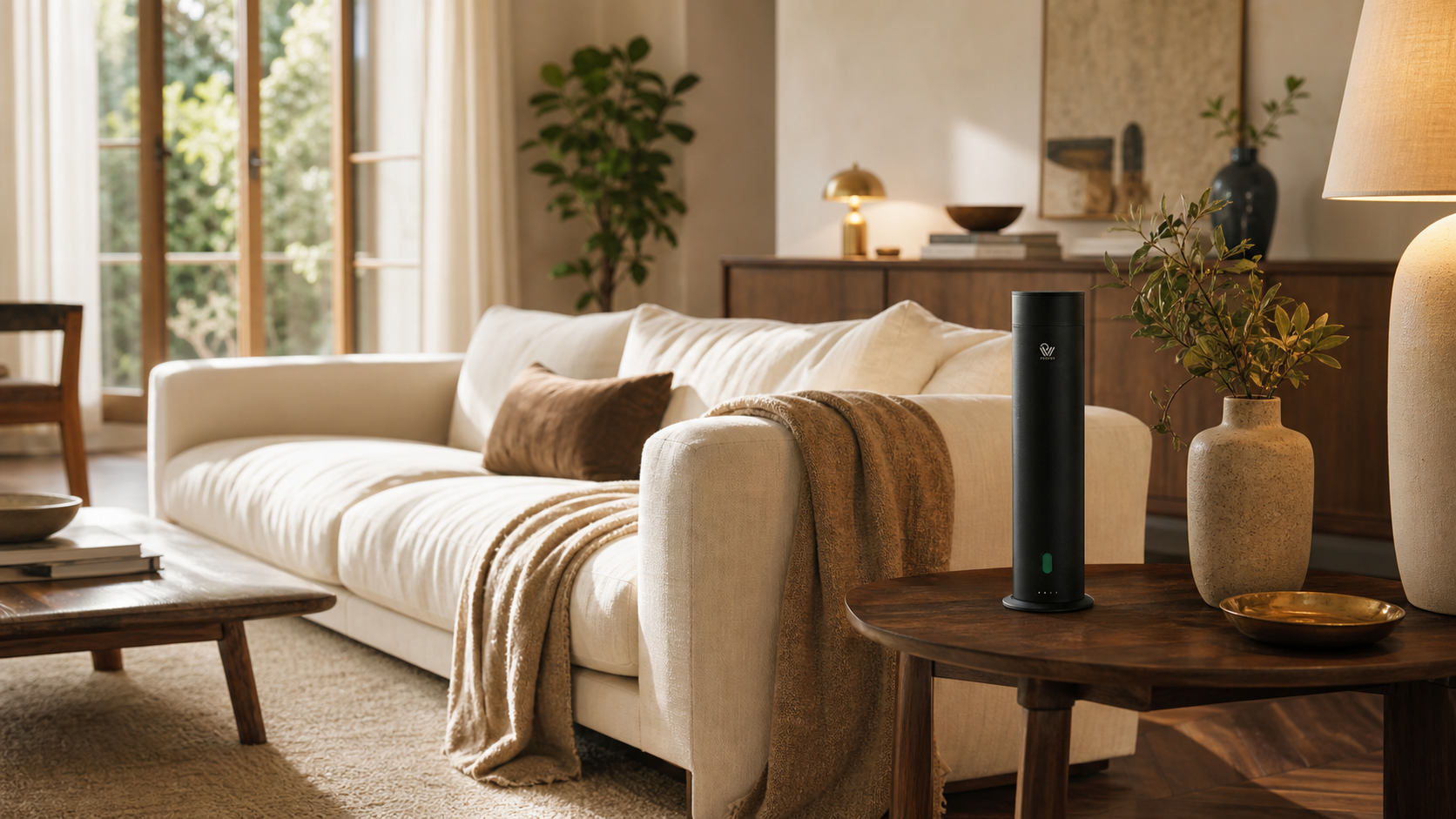
A room can look complete and still feel quietly unresolved. The sofa is beautiful, the paint was chosen with care, yet the space feels colder, busier or harder to settle into than intended. Sensory interior design helps explain why. It treats a room not as one picture to style, but as interacting layers your body reads while you live there.
This guide uses five practical layers: light, touch, sound, air and scent. They form a home-audit model, not a list of the body's classical five senses. The aim is not to add more stimulation. It is to find the one signal that conflicts with the room's purpose and make the smallest useful change. This is a general interior guide rather than a clinical or neurodivergent sensory-room plan. Individual accessibility or health needs may call for specialist advice.
What sensory interior design changes
Most rooms are planned from the visible centre outwards. We choose a palette, furniture and objects, then judge the result from a doorway or camera. Everyday experience works differently. A chair is encountered through its fabric, conversation through its echo and afternoon light through glare from the seat that looked perfect in a photograph.
Experimental psychologist Charles Spence describes built environments as experiences assembled from interacting sensory channels. Adding pleasant cues does not guarantee a better result. Studies in his review of ambient scent produced outcomes that depended on context, intensity and congruency.
U.S. Houzz searches rose for sandstone, linen wallpaper, wellness rooms and sensory rooms between January-March 2025 and the same period in 2026. This is one platform's U.S. data, not evidence of European demand. It signals interest in tactile experience alongside visual style.
Begin with three words
Choose one moment in the room: arriving home, reading, talking, working or settling into the evening. Then write three words for how that moment should feel. Avoid style labels such as minimalist or classic. Choose felt qualities: clear, quiet, grounded; warm, intimate, unhurried; or bright, open, focused.
These words become the filter. A lamp, rug or fragrance is useful when it supports the intended experience without creating another conflict.
Write the words down. Rooms drift as lamps move, rugs disappear and habits change. A short brief helps you notice when a space has lost its thread. It can also make choices in a shared home easier: two people may agree on calm, warm and uncluttered long before they agree on a particular chair.
Score each layer from 1 to 5:
- 1: actively conflicts with the intended feeling
- 2: regularly distracts from it
- 3: neutral or inconsistent
- 4: usually supports it
- 5: supports it naturally without demanding attention
This is a subjective baseline, not a scientific measurement. Its value lies in comparison. Change one variable, use the room normally and score that layer again.
The five-layer sensory audit
| Layer | Signal to notice | Sixty-second test | Smallest intervention | Success may feel like |
|---|---|---|---|---|
| Light | Glare, flat brightness, deep shadow or weak task visibility | Sit in the usual position by day and after dark; find the brightest source in your normal view | Reposition or soften one lamp, or add targeted task light | You can use the room without squinting or avoiding a bright source |
| Touch | Scratchy, cold, slippery or unsupportive contact points | Use the chair, handle, rug or bedding for several minutes | Change the material where the body actually meets the room | You stop shifting because of that contact point |
| Sound | Echo, traffic, appliance hum or recurring interruption | Clap once, speak from the main seat and switch devices off in turn | Move an existing textile or bookcase, or isolate one noisy device | Speech feels less sharp or the distraction becomes less prominent |
| Air | Stuffiness, draught, lingering source scent or uneven temperature | Check windows, extraction, drains, bins and textiles before adding fragrance | Ventilate where appropriate and address the source | The room feels fresher without needing scent to conceal it |
| Scent | A dominant, competing or unclear background | Step outside briefly and re-enter; use the contrast as an observation, not a measurement | Lower or remove one scent source | The room keeps its identity while fragrance stays in the background |
Lighting quality is more than brightness. The International Commission on Illumination notes that use, surfaces, colour and glare affect the result. Indoor environmental quality is similarly connected: ASHRAE groups air quality, thermal conditions, lighting and acoustics as interdependent factors.
The audit is therefore not a shopping list. In sensory interior design, subtraction is often a deliberate design choice.
Find the conflict before choosing the solution
A room can contain beautiful elements that send different messages. Bright glare and hard echo may make a living room feel sharp even when its palette is warm. Heavy textiles and stagnant air can make comfort feel dense. Several scented products can compete with flowers, food and each other.
Start with a precise observation. Replace the room feels wrong with the exposed bulb is in my direct view or speech sounds sharp from this seat. A specific conflict invites a reversible response.
| Combination | Likely tension | First test |
|---|---|---|
| Glare and echo | Visually and acoustically sharp | Redirect one light source, then listen again before adding decor |
| Soft, warm materials and stale air | Comfortable styling that begins to feel heavy | Improve appropriate ventilation before adding fragrance |
| Several scent sources, flowers and food | No clear atmospheric hierarchy | Remove added scent during meals or naturally fragrant activities |
| Low ambient light and a dark route | An unclear transition through the room | Add local path or task light instead of brightening everything |
| Polished styling and a rough contact point | A room that looks resolved but feels uncomfortable | Change the contact material before replacing furniture |
Soft, porous furnishings may reduce some sound reflections, although the result depends on material, area and placement. A warmer lamp may still create glare. Treat each intervention as a test in the actual setting rather than a universal rule.
A ten-minute room edit
1. Choose one moment
Audit the entrance after dark, the chair used for reading or the table during conversation. A single activity gives the room a clear purpose.
2. Use the normal position
Sit and stand where you actually spend time. Look from eye level. Touch the materials, open the curtain and operate the handle involved in the moment.
3. Test each layer
Find the brightest source, listen for one recurring sound, notice the main contact material and check the air before considering fragrance. Record the five scores.
4. Name one conflict
Choose the signal that most clearly interrupts your three words. Do not redesign the whole room around a vague impression.
5. Change one variable
Move, remove, lower, soften or ventilate. Keep every other layer stable so the result remains understandable.
6. Return to the real activity
Judge evening lighting in the evening and conversation acoustics while speaking from the usual seats. After time away, re-entering may make a scent contrast easier to notice. Treat that as a practical observation, not a calibrated intensity test.
Four moments that reveal different problems
Arriving home
Stand outside after dark, then enter as usual. Can you see the route and the place for keys without flooding the whole entrance with light? Does the first handle or surface feel secure? Improve clarity before adding decoration.
Conversation
Sit in the main living-room positions and speak at a normal level. One clap may reveal an obvious echo, although it is not a professional acoustic assessment. Check glare from both seats and the materials people touch for longer periods. Fix the weakest layer first.
Focused work
Test whether a directional light defines the work surface without shining into your eyes. Notice the desk edge, chair and intermittent device noise. At the end of the day, switch off or remove one work cue so the room can support a different moment.
The evening
View the room from the seat you use at night. Identify its brightest source and most irregular sound. Lower one signal and notice whether the room becomes easier to read as an evening space. The aim is a clearer transition, not a promise of better sleep.
Where scent belongs
Scent is a finishing layer. Context, prior associations and other cues influence how a fragrance is interpreted. A profile that feels grounded in one room may feel heavy in another because the light, air, materials and activity differ.
Resolve ventilation and unwanted source scents first. The U.S. Environmental Protection Agency notes that fragrances can cause adverse effects in some sensitive individuals, while the extent and mechanisms are not fully understood. Ask before using fragrance around sensitive guests, follow product instructions around children and animals, and stop use and ventilate if anyone experiences discomfort.
When fragrance suits the moment, begin at low intensity and change one setting at a time. A waterless diffuser with adjustable intensity and timing, such as Pip & Wells waterless scent diffuser, can support that measured approach without water or heat. Layout, airflow, open doors and personal sensitivity still shape perception.
For the fragrance itself, use the existing guide to matching home fragrance to your interior. The guide to choosing home fragrance online owns the comparison of notes and fragrance families. When visitors are involved, scenting your home before guests arrive covers timing and restraint. Keeping those decisions separate protects this article's purpose: finding the conflict before selecting a product.
No added scent can also be the more considered choice. Let food, flowers, fresh baking or a fireplace keep their own presence. Neutral intervals create contrast and stop fragrance from becoming the automatic answer to every atmosphere.
Read the room a second time
Sensory interior design does not need to produce a dramatic before-and-after photograph. Its success may be a lamp that no longer glares, a conversation that feels less sharp, a surface you enjoy touching or air that feels fresher before fragrance enters the room.
Use the room normally for a few days, then score the layers again against your three words. Because you changed only one variable, you can judge what it actually did. Sometimes the next conflict becomes clearer; sometimes the first small edit is enough.
Begin with three words. Score the five layers. Find one conflict and make one reversible change. Then take one honest second look. A room becomes coherent gradually, when every element supports the way you actually live in it.
Frequently asked questions
What is sensory interior design?
Sensory interior design considers how light, touch, sound, air, scent and movement shape the experience of a room. It aligns these layers with a specific activity and intended feeling.
Is sensory interior design the same as a sensory room?
Not necessarily. This article offers a general home-editing method. Clinical, educational, therapeutic or neurodivergent sensory rooms may require individual assessment and specialist guidance.
Do I need to buy anything for a sensory audit?
No. Begin by moving, removing, adjusting, switching off or ventilating. Buy something only when the audit identifies a precise problem that existing elements cannot solve.
How do I know which layer to change first?
Choose the signal that repeatedly interrupts the activity: glare while reading, an uncomfortable contact point, echo during conversation, stale air or competing fragrance. Change only that variable and compare the result.
Where should fragrance fit?
Treat fragrance as a finishing layer after light, contact comfort, sound and air have been considered. Start low, avoid competing sources and allow for unscented moments and sensitive visitors.