

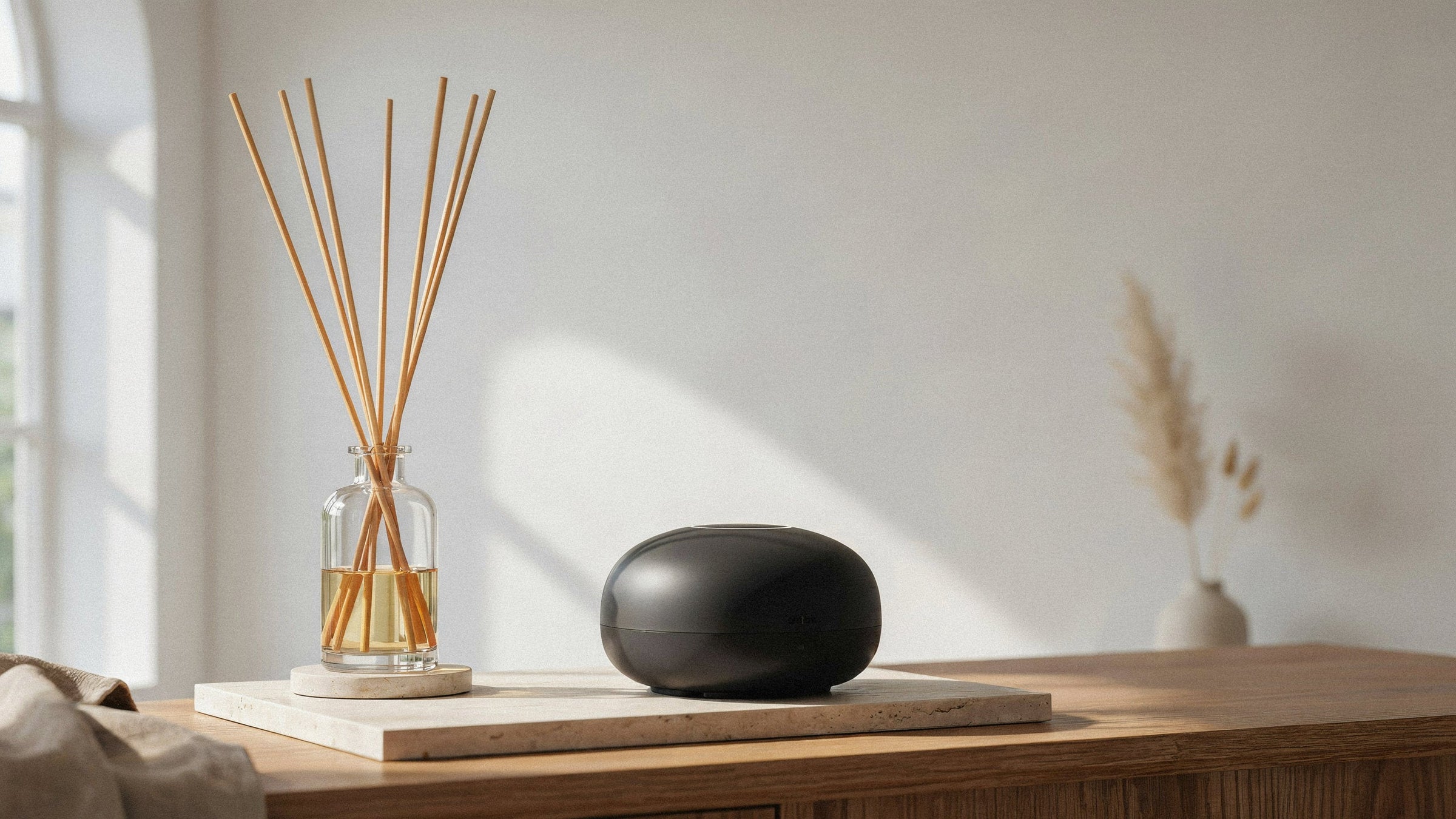
The living room is the hardest room in the house to scent well. It is the largest space, it usually opens onto a hallway or kitchen, and it is the room where people actually sit. The fragrance has to reach the sofa without dominating the room. That is where reed and electric diffusers stop being interchangeable.
The Short Answer
A reed diffuser scents roughly 5 to 10 m² of enclosed air. A living room is usually 25 to 60 m² and rarely enclosed. For most living rooms an electric diffuser is the better fit, because it projects fragrance across the room and lets you set the intensity. Reeds remain the better choice in small, quiet, enclosed spaces.
The Difference in One Line
A reed diffuser waits for the oil to evaporate. An electric diffuser pushes it into the air. Everything else follows from that.
Reeds are passive: rattan sticks draw scented oil from a bottle and release it slowly through evaporation. No power, no sound, no controls. An electric diffuser is active: it uses energy to disperse fragrance as a fine mist or as dry micro-particles of pure oil. Because it does the work rather than waiting for it, it fills far more air — and it lets you decide how much scent is released, and when.
Room Size: Where Reeds Run Out
This is the decisive factor, and it is worth doing the arithmetic rather than guessing.
A reed diffuser is designed for roughly 5 to 10 m² of enclosed air. A typical living room is 25 to 40 m², an open-plan living and dining space often 50 to 60 m², and both usually have an opening to another room and a ceiling above 2.5 metres. So the room is three to six times the volume the reeds were built for, with air escaping continuously.
The result is familiar. You smell the fragrance clearly when you lean over the table it sits on, and almost nowhere else. That is not a weak oil. It is a delivery method working past its range.
A cold-air electric diffuser such as the Pip & Wells waterless scent diffuser disperses fragrance as an ultra-fine dry mist across spaces up to approximately 100 m², which puts the scent where people sit rather than where the bottle stands.
Control: One Setting Versus Several
A reed diffuser has exactly one setting: on. It cannot be paused, scheduled or turned down. It evaporates oil overnight, while you are at work, and during the two weeks you are away.
An electric diffuser gives you three levers that matter in a living room:
- Intensity — a low, steady background level for an ordinary evening, a step up an hour before guests arrive.
- Timing — run it when the room is in use, not when it is empty.
- Consistency — the same strength on the last day of a bottle as on the first, because output does not depend on how much oil is left.
That last point is the one people notice most. Reeds start strong and taper; an electric device does not.
Noise
Reeds are silent — genuinely, completely. That is their real advantage in a bedroom or a room where you read.
Electric diffusers vary. Ultrasonic models produce a low hum and occasional water sounds. Cold-air models run near-silently on low and medium settings, with a soft air-pump hum only at maximum output. In a living room, where there is usually conversation, music or television, neither is intrusive. In a silent room at night, the difference is worth weighing.
Maintenance
Reeds need almost nothing: flip the sticks occasionally, replace them when they saturate. A cold-air electric diffuser needs the oil bottle replaced and nothing else — there is no water tank, so no cleaning cycle. An ultrasonic diffuser is the outlier here: standing water means the reservoir needs cleaning weekly, or residue makes fresh oil smell stale.
Running Cost Over a Year
Reeds look cheaper because the bottle costs less. The catch is that a reed bottle empties whether the room is in use or not — usually within two to three months, and you cannot slow it down.
An electric diffuser costs more up front and then consumes oil only while running. In a living room used a few hours each evening, a 120 ml bottle typically lasts two to four months, and you control which end of that range you land on. Over a year, in a room this size, the gap in running cost is usually smaller than the difference in purchase price suggests. The detail is in how long diffuser oil lasts.
When a Reed Diffuser Is Still the Right Choice
Reeds are not a lesser product. They are a product for a different room.
They are the better option in a cloakroom, a hallway, a small home office or on a bedside table — anywhere the space is small and enclosed, the traffic is low, and silence matters more than reach. In those rooms an electric diffuser is over-specified, and the reeds will do the job with no power, no settings and no upkeep.
The question is not which product is better. It is which one matches the volume of air you are trying to scent.
The Verdict for a Living Room
For a living room of 25 m² or more, an electric cold-air diffuser is the better choice. It covers the volume of the room, carries fragrance to the seating area, holds a consistent strength across the life of a bottle, and stops when you want it to.
Pair it with a fragrance composed for an open, social space. The One and Ocean Breeze were built for exactly that, and the hotel fragrance oil collection lets you find the profile that suits your room. If it is a gift, the gift sets pair the diffuser with three 120 ml oils.
Frequently Asked Questions
Is a reed diffuser strong enough for a living room?
In most living rooms, no. Reed diffusers suit roughly 5 to 10 m² of enclosed air, while a living room is usually 25 to 60 m² and often open to other rooms. The scent stays near the bottle rather than reaching the seating area. For a space that size, an electric cold-air diffuser carries fragrance much further.
What is the difference between a reed diffuser and an electric diffuser?
A reed diffuser is passive — rattan sticks release scented oil slowly through evaporation, with no power and no controls. An electric diffuser is active, projecting fragrance into the air as a mist or dry micro-particles. That covers a larger room and gives control over intensity and timing.
Are electric diffusers noisy in a living room?
Cold-air models run near-silently on low and medium settings, with a soft air-pump hum only at maximum output. Ultrasonic models produce a low hum and occasional water sounds. In a living room with conversation or music, neither is usually noticeable.
Which is cheaper to run over a year?
Closer than it looks. A reed bottle costs less but empties continuously whether the room is used or not, usually in two to three months. An electric diffuser consumes oil only while running, so a 120 ml bottle typically lasts two to four months and you control which end of that range applies.
When is a reed diffuser still the best option?
In small, enclosed, low-traffic spaces: a cloakroom, a hallway, a home office, or a bedside table where silence matters. There they give gentle, constant fragrance with no power and minimal upkeep, and an electric diffuser would be over-specified.
Related: The Best Scent for Your Living Room · Which Scent Diffuser Is Best? · Why Doesn't My Home Smell Good for Long?