

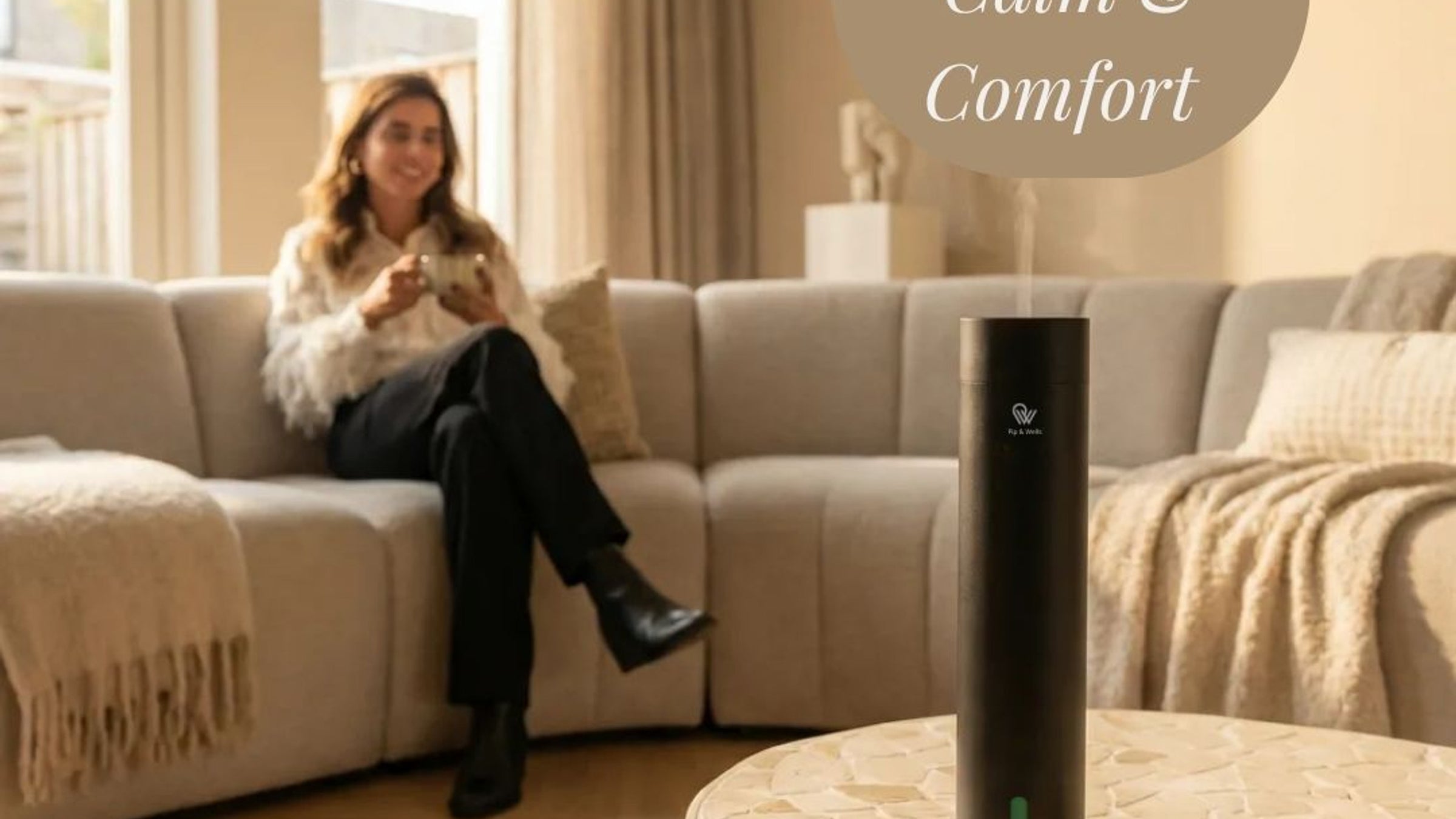
The living room is the room your guests experience first, the room you spend most evenings in, and the largest shared space in most homes. That combination makes it the hardest room to scent well — and the one where getting it right changes the most.
The Short Answer
Three fragrance families suit a living room: warm woods and amber for classic or layered interiors, fresh and light for minimal or Scandinavian spaces, clean and coastal for contemporary open-plan rooms. Whichever you choose, the room is usually too large for a candle or reeds to reach — the delivery method matters as much as the fragrance.
What a Living Room Scent Has to Do
Choosing a scent for a living room is different from choosing one for a bedroom or a bathroom. It has to do four things at once: feel warm without being sweet, feel refined without being cold, hold up across a large space, and stay pleasant with repeated daily exposure. Not every fragrance manages all four.
Warmth at the base
Living rooms benefit from fragrances that feel grounded. Warm base notes — sandalwood, cedar, amber, soft musk — create depth that lighter scents cannot match. They also travel well across larger spaces and linger at a pleasant level after the diffuser has stopped.
Sophistication at the top
The first thing someone smells on entering should feel considered rather than cheerful. Bergamot, light citrus peel, green tea or subtle herbs read as refined — an important distinction in a room built for conversation.
Complexity without loudness
A good living room scent has layers. You should still find nuance in it after an hour in the room. At the same time it should never dominate. The best home fragrances are noticed when you arrive and forgotten when you stay.
Consistency across the day
The living room is used morning, afternoon and evening. A fragrance that feels right at 9 p.m. but heavy at 10 a.m. is the wrong choice for this room.
Why This Room Matters Most
Smell reaches the limbic system — the region handling emotion and long-term memory — by a more direct route than the other senses. That is part of why a scent can return a place to you years later, though the relationship between smell and memory is more complicated than the popular version suggests.
What is clear enough in practice: hotels treat the lobby fragrance as the most carefully chosen scent in the building, because it is what a guest meets first. Your living room does the same job in your home. It is worth the same attention. There is more on how that works in what a luxury hotel actually smells like.
The Three Fragrance Families That Work Best
Warm woods and amber
This is the hotel-lobby category. Sandalwood, cashmere wood, amber and restrained vanilla suggest craftsmanship and permanence. The family works particularly well in living rooms with natural materials: wood floors, linen upholstery, leather furniture, stone surfaces.
The One sits in this category. It was built around the scent profile of a high-end hotel suite — warm and anchoring, with a depth that registers as expensive without announcing itself. It is the most frequent choice for living rooms and entryways.
Fresh and sophisticated
If your living room is lighter — pale woods, white walls, neutral palette, plenty of daylight — a warm wood fragrance can feel heavy during the day. A fresher composition usually suits the space better: white tea, fig leaf, green stems, subtle clean florals. These create a sense of space without sacrificing depth.
Day Dream fits this profile — lighter and more open, and comfortable across a full day without becoming tiring.
Clean and coastal
For contemporary or minimalist rooms — open-plan spaces with concrete, glass or light oak — a clean coastal fragrance often fits better than anything warm or heavily woody. Light salt air, subtle marine notes, clean white musk.
Ocean Breeze works in this context: open and fresh, considered rather than aggressive.
What to Avoid
Some fragrance types that work elsewhere do not translate to a shared living space.
- Heavy florals — rose, lily, tuberose at full volume — can overwhelm a room where several people spend extended time. What smells beautiful alone in a shop can feel intrusive mid-conversation.
- Sweet gourmand scents — vanilla cupcake, caramel, cinnamon bun — read as appetite-driven and sit oddly in a room that is not a kitchen. They also tire quickly with repeated exposure.
- Single-note fragrances — pure lavender, plain citrus, undifferentiated musk — lack the complexity to survive daily exposure. They turn invisible or irritating faster than layered compositions.
- Aggressive synthetic "clean" scents — the ones that smell of laundry detergent or surface spray — read as cleaning product rather than fragrance.
A useful test: if the fragrance reminds you of a specific product rather than a specific place, it is not right for a living room.
Matching Scent to Interior Style
A fragrance that reinforces the visual character of a room adds to the coherence of the whole. One that contradicts it creates a quiet dissonance a visitor notices without being able to name.
- Classic or traditional — warm woods, soft amber, subtle depth. Leather, dark wood, woven textiles. The One is the natural fit.
- Scandinavian or minimalist — clean, light, understated. White tea, pale wood, soft linen. Day Dream works here.
- Coastal or contemporary — open, fresh, architectural. Marine notes, clean musk, airy accords. Ocean Breeze fits cleanly.
- Warm bohemian or layered — amber, soft spice, fig. Warmth with character. The One again, or a rotation between The One and Day Dream.
The full breakdown by interior style is in which home fragrance matches your interior style.
Getting the Scent Across the Room
The fragrance is half the equation. The delivery method decides whether you experience it as designed or as a diluted, localised version.
Living rooms present a specific problem: they are the largest shared space in most homes, often open-plan, and usually connected to a dining or kitchen area. Point-source solutions — candles, reed diffusers — cannot reach across that. Reeds are built for roughly 5 to 10 m² of enclosed air, against a living room of 25 to 60 m². You end up with a fragrant corner and a neutral room.
A cold-air nebulising diffuser solves this. It disperses fragrance evenly across up to approximately 100 m², so the scent you chose is what fills the room rather than what sits near the device. The Pip & Wells waterless scent diffuser was designed for exactly this kind of space — on a shelf or console, running quietly, creating the atmosphere across the whole room.
The comparison between delivery methods is in which scent diffuser is best, and the reed-versus-electric question specifically in reed versus electric diffusers for a living room.
The Complete Setup
- Choose your fragrance family. Warm and anchored for a classic or layered interior. Fresh and light for a minimal or Scandinavian space. Clean and coastal for a contemporary open-plan room.
- Position the diffuser centrally. A shelf or console at 80–120 cm gives the best distribution. Avoid corners — the fragrance pools rather than travels.
- Start on the lowest setting. Living rooms are larger than they feel, but low intensity is usually enough. Increase over a few days only if needed.
- Run it one to two hours before guests arrive. That gives the fragrance time to spread evenly. Running it continuously is unnecessary and means your own nose stops registering it.
- Choose one scent and stay with it. Consistency is what builds the association. The more familiar the fragrance becomes in the space, the more strongly it works on everyone who enters.
Frequently Asked Questions
What is the best scent for a large open-plan living room?
Large open-plan spaces need warm base notes — sandalwood, amber or cedar — combined with a diffuser that can actually cover the floor area. The Pip & Wells waterless scent diffuser covers up to approximately 100 m², which handles most open-plan living and dining areas with one device. The One is the usual recommendation for this kind of space.
Should I use the same scent in my living room and bedroom?
You can, but a more considered approach uses your signature scent in the main living space and something lighter in the bedroom. That creates a sense of progression through the home rather than uniform saturation. Day Dream works well as a bedroom companion to The One in the living room.
How long does it take for a fragrance to fill a living room?
With a cold-air diffuser on medium intensity, a typical living room reaches an even level within 15 to 25 minutes. For a large open-plan space, allow up to 40 minutes. Running it for an hour before guests arrive is a reliable approach.
Is a reed diffuser enough for a living room?
For a small room under 15 m², a reed diffuser gives pleasant background fragrance. For a typical living room of 25 to 40 m² or larger, reeds only scent the immediate area around the bottle. Covering the full room needs a cold-air nebulising diffuser with adequate output.
Should my living room scent change with the seasons?
It can, though it does not have to. Some people move to warmer, deeper scents in autumn and winter and lighter ones in spring and summer. Others keep one signature year-round. The year-round approach builds a stronger sensory identity for the space; seasonal rotation keeps it feeling current.
Can I run a diffuser alongside a wood-burning stove or fireplace?
A cold-air diffuser produces no heat and no flame, so it can run alongside a fireplace. Position it away from the direct heat source and keep the room ventilated. Follow the instructions supplied with your device and fragrance oil.
Related: Which Home Fragrance Matches Your Interior Style? · What Does a Luxury Hotel Actually Smell Like? · Which Scent Diffuser Is Best?